
Outsourcing vs external procurement: MaRisk rules in 2026

For outsourcing vs external procurement, the German Minimum Requirements for Risk Management (MaRisk) ask one question: would the institution otherwise perform the activity itself? Since the ninth MaRisk amendment of 30 June 2026, services covered by the EU Digital Operational Resilience Act (DORA) also fall outside the MaRisk outsourcing module, AT 9.

Ask what you would otherwise do yourself. Under AT 9 no. 1, an outsourcing exists if another company performs activities and processes that the institution would otherwise perform itself. Other external procurement is not outsourcing, but the institution must still pay attention to it. ICT (information and communication technology) services under DORA follow DORA, not AT 9.

Legal position
MaRisk, 30 June 2026
Applies to
Banks in Germany
Reading time
16 minutes
Last updated
30 October 2026

The essentials in four points

01

The test

One question

An outsourcing exists if another company performs activities and processes that the institution would otherwise perform itself (AT 9 no. 1). The contract form does not decide: civil-law arrangements cannot rule an outsourcing out.

02

Not outsourcing

Other external procurement

One-off or occasional purchases of goods and services, and services that supervised firms typically provide and that the institution cannot supply itself for factual or legal reasons, are other external procurement.

03

From 30 June 2026

DORA ICT services

ICT services under Article 3 no. 21 DORA that are subject to ICT third-party risk management under Articles 28 to 30 DORA fall outside AT 9. The circular entered into force on publication, with a transition period to 1 January 2027.

04

The consequence

Classify, then manage

Outsourcings need a risk analysis that shows which are material. § 25b (1) of the German Banking Act (Kreditwesengesetz, KWG) requires a register of all material and non-material outsourcings, and the institution stays responsible (§ 25b (2) KWG).

Who does what: supervisors and providers

The rule is an administrative circular, not a statute, and it sits on a statutory base. This overview helps if your head office is outside Germany and the German structures are new to you.

BaFin

BaFin (the German Federal Financial Supervisory Authority, Bundesanstalt für Finanzdienstleistungsaufsicht) issues the MaRisk circular for banks and supervises how institutions apply AT 9, the outsourcing module.

Bundesbank

The Deutsche Bundesbank, the German central bank, publishes the MaRisk together with BaFin and takes part in the ongoing supervision of institutions.

DORA framework

The EU Digital Operational Resilience Act (Regulation (EU) 2022/2554) sets the ICT third-party risk rules. Since 30 June 2026, AT 9 points to Article 3 no. 21 and Articles 28 to 30 DORA to draw the line.

Your institution

The institution classifies each external service, decides which outsourcings are material and stays responsible for compliance (§ 25b (2) KWG). The outsourcing provider has no say in the classification.

Service provider

The provider performs the service under a written agreement with instruction and termination rights (§ 25b (3) KWG). Whether it counts as outsourcing is decided by the test, not by the provider.

Outsourcing vs external procurement: the test in AT 9

The circular gives the test, not a list of services. The table applies it to typical services and is our reading, not a BaFin list.

ServiceClassificationReason
One-off legal opinion on a product questionOther external procurementA one-off purchase of a service.
Ongoing customer service for card holdersOutsourcingThe institution would otherwise provide the service itself.
Standing internal audit work by an audit firmOutsourcing, usually materialA special function that is otherwise performed inside the institution.
Standing external Money Laundering Reporting Officer (MLRO)Outsourcing, with duties under the German Anti-Money Laundering Act (Geldwäschegesetz, GwG) on topThe function is otherwise performed by the institution itself.
A service that only supervised firms supply and the institution cannot provide itselfOther external procurementTypically bought from a supervised firm and not providable by the institution, for factual or legal reasons.
Cloud hosting that is subject to DORA ICT third-party risk management
New since 30 June 2026
DORA, not AT 9Excluded by the explanation to AT 9 no. 1.

Key point

Classify every service once and write down why.

AT 9 no. 1 says that civil-law arrangements cannot rule out an outsourcing. Record the question you asked and the answer, for outsourcings and for purchases you leave out.

The explanation to AT 9 no. 1 describes other external procurement in two groups: one-off or occasional purchases of goods and services, and services that supervised firms typically provide and that the institution cannot supply itself for factual or legal reasons.

This article follows the MaRisk circular for banks, Circular 06/2026 (BA). Payment institutions have their own circular with its own AT 9 (Circular 07/2024 (BA)). We have not checked whether it has been updated to match the new DORA wording, so check which circular applies to you.

Deadlines and milestones

Chips in red mark steps that are still ahead.

  1. 17 January 2025

    Done. DORA applies. ICT third-party risk management now follows Articles 28 to 30 DORA for the firms in its scope.

  2. April 2026

    Done. BaFin consults on the draft of the ninth MaRisk amendment.

  3. 30 June 2026

    Done. BaFin publishes the final MaRisk as Circular 06/2026 (BA). It enters into force on publication and replaces the previous version.

  4. 1 January 2027

    Open. The transition period ends for requirements that are new in individual cases. Relief can be used from 30 June 2026.

What the law requires

§ 25b (1) KWG requires an institution to take adequate precautions against excessive additional risks, depending on the nature, scale, complexity and risk content of an outsourcing of material activities and processes. An outsourcing must not impair the orderliness of the business or the business organisation, and risk management must stay adequate and effective and include the outsourced activities. The institution must keep a register of all material and non-material outsourcings (§ 25b (1) sentence 4 KWG).

§ 25b (2) KWG says that outsourcing must not transfer the responsibility of the managing directors to the provider. The institution stays responsible for complying with the statutory provisions that apply to it.

§ 25b (3) KWG requires a written agreement that sets out the institution’s rights, including instruction and termination rights, and the provider’s corresponding duties. BaFin’s rights of information and audit, and those of the institution’s auditors, must stay secured, also for providers in other states. For a material outsourcing to a provider in a third country, the agreement must ensure that the provider names a domestic agent for service of process.

AT 9 no. 2 adds the method. The institution assesses the risks of an outsourcing in a risk analysis that covers all relevant risks, and it decides on that basis which outsourcings are material.

The circular entered into force on 30 June 2026. Where it creates additional requirements in individual cases, a transition period runs until 1 January 2027, according to BaFin’s transmittal letter.
ICT services: the DORA path

The explanation to AT 9 no. 1 now states that outsourced or externally procured ICT services under Article 3 no. 21 DORA that are subject to ICT third-party risk management under Articles 28 to 30 DORA do not fall under AT 9. Those services are managed under DORA instead.

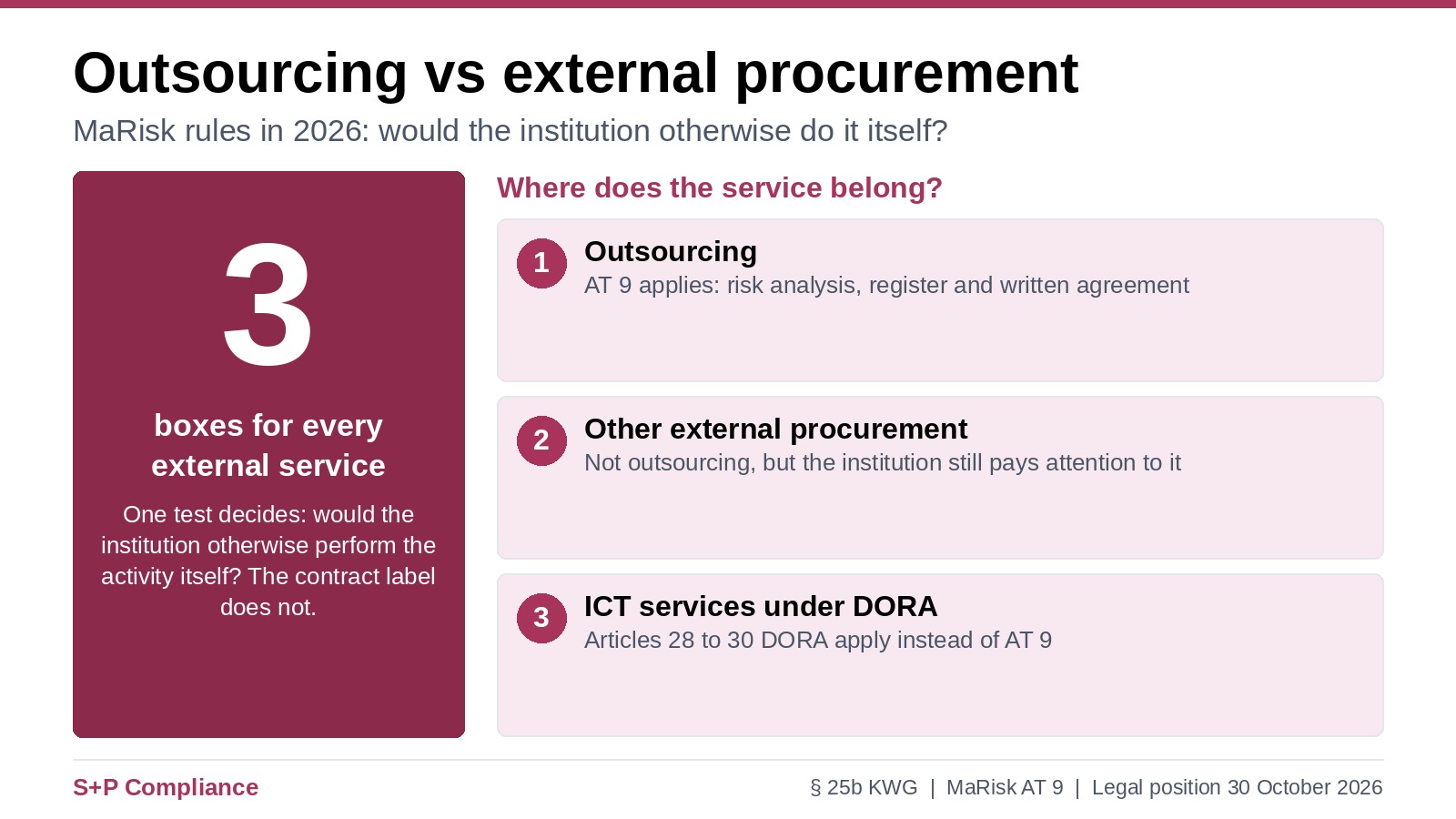
In practice, each external service lands in one of three boxes: outsourcing under AT 9, other external procurement, or an ICT service under DORA. On our reading, a service that mixes ICT and other parts needs a reasoned split, because AT 9 and DORA each cover only their own part.

§ 28 (6) no. 1 of the German Act on the Federal Office for Information Security (BSI-Gesetz, BSIG) says that §§ 30, 31, 32, 35, 36, 38 and 39 BSIG do not apply to financial undertakings under Article 2 (2) DORA, nor to firms to which DORA applies under § 1a (2) and (2a) KWG. For your institution, the DORA path therefore replaces those BSIG duties. On our reading, a provider that is not itself a financial undertaking can fall under the BSIG as an important or essential entity. That is the provider’s own obligation. It does not change which regime your institution applies to its contract.

Duties by function

Different people carry different parts of the work. The split below follows the functions that usually exist in a German institution.

Management

Sets the outsourcing policy, owns the classification rules and remains responsible for compliance. Management tasks cannot be handed to a provider (§ 25b (2) KWG).

Outsourcing management

Supports the business units, coordinates and reviews their risk analyses and keeps the outsourcing register (AT 9). It is the single place where the three boxes meet.

Business units and procurement

Ask the classification question at intake: would we otherwise do this ourselves? They give the facts for the risk analysis.

ICT risk function

Runs the DORA path for ICT services that fall under Articles 28 to 30 DORA, outside AT 9.

Internal audit

Checks that classification, risk analysis and register are complete and that the reasoning is recorded.

What stays with your firm

Stays with you

  • Classification of each external service: outsourcing, other external procurement or DORA
  • The decision which outsourcings are material, based on your risk analysis (AT 9 no. 2)
  • Management responsibility, which cannot be transferred (§ 25b (2) KWG)
  • The decision to enter into, renew or end an outsourcing agreement
  • Reports to the Financial Intelligence Unit (FIU) under § 43 GwG, where AML tasks are outsourced

A provider can prepare and run

  • An inventory of external services with a first classification proposal for your sign-off
  • Drafts of risk analyses that your business units and management review
  • Maintenance of the register entries from your data
  • Contract and exit-plan reviews against your checklist
  • Reporting packs for management and audit

You hand over the task, not the control. § 25b (2) KWG keeps the responsibility of the managing directors, and the compliance with the statutory provisions, with the institution, whatever the agreement says.

Typical weak points

These six points recur where outsourcing is classified by habit and not by the test. They do not replace a review of your own set-up.

Classifying by contract label

Calling a contract a purchase or a licence does not decide the question. Civil-law arrangements cannot rule out an outsourcing.

AT 9 no. 1

Treating every purchase as outsourcing

Everything in the register inflates the effort. The test is whether the institution would otherwise perform the activity itself.

AT 9 no. 1

Ignoring other external procurement

Not being an outsourcing does not mean no control. The institution must still pay attention to it.

AT 9, explanation to no. 1

Keeping the old ICT assumptions

ICT services under DORA now follow DORA. Applying AT 9 in parallel duplicates work or leaves gaps.

Articles 28 to 30 DORA

An incomplete register

The register must list all material and non-material outsourcings, not only the material ones.

§ 25b (1) KWG

Responsibility shifted to the provider

An agreement can transfer a task but not management responsibility or legal compliance.

§ 25b (2) KWG

Quick check: where does your institution stand?

Select a status for each of the six questions. Nothing is stored or sent. The check is a self-assessment and does not replace legal advice.

Do you ask “would we otherwise do this ourselves?” for every external service? AT 9 no. 1

Fulfilled

The question is part of intake. Keep the answers on file.

Partly

The question is asked for some services only. Make it a fixed step in procurement and in contract renewals.

Open

Classification follows the contract label or the vendor’s view. Define the test and apply it to the inventory.

Do you record the reasons for each classification, including purchases you treat as other external procurement? AT 9 no. 1

Fulfilled

Reasons are recorded for both outcomes. Review a sample each year.

Partly

Reasons are recorded for outsourcings only. Add a short note for each purchase you leave out.

Open

No reasons are recorded. Start with the largest providers and write down the question and the answer.

Do you separate DORA ICT services from AT 9 outsourcings in your inventory? AT 9, explanation to no. 1

Fulfilled

The inventory has three boxes and a clear owner for each.

Partly

The split exists for new contracts only. Re-classify the existing providers.

Open

ICT services are still treated under AT 9 alone. Map each provider to Articles 28 to 30 DORA or to AT 9.

Do you assess the risks of each outsourcing and decide which are material? AT 9 no. 2

Fulfilled

A risk analysis exists per outsourcing and drives the materiality decision.

Partly

Risk analyses exist, but the materiality decision is not derived from them. Link the two in writing.

Open

Materiality is decided by contract value or by habit. Introduce a risk analysis and keep it current.

Does your register list all material and non-material outsourcings? § 25b (1) KWG

Fulfilled

The register is complete and has an owner.

Partly

Only material outsourcings are listed. Add the non-material ones.

Open

There is no register, or it sits in several files. Consolidate it in one place.

Have you mapped the new MaRisk text against your outsourcing policy before 1 January 2027? Circular 06/2026 (BA)

Fulfilled

The gap analysis is done and the actions are planned.

Partly

The review has started. Finish it before the transition period ends.

Open

Your policy still follows the previous version. Start with the DORA line and the register.

No-regret measures

These six steps hold whichever way supervisory practice develops. They build the evidence that a supervisor asks for.

01

Build one inventory

List every external service with owner, provider and a first classification. One list is the base for everything else.

02

Add a classification step to procurement

Put the question “would we otherwise do this ourselves?” into intake and renewals, with a short written answer.

03

Split the DORA path

Mark ICT services that fall under Articles 28 to 30 DORA and hand them to the ICT risk function.

04

Review the risk analysis

Check that each outsourcing has a risk analysis and that the materiality decision follows from it.

05

Complete the register

Add the non-material outsourcings and check that every entry has an owner and a review date.

06

Plan the 1 January 2027 date

Map the new MaRisk text against your policy, assign actions and record the result.

Conclusion: classify, separate, document

Three key messages remain.

Ask one question

Would the institution otherwise perform the activity itself? That decides outsourcing, not the contract label.

Keep three boxes

Outsourcing under AT 9, other external procurement, and ICT services under DORA.

Write down the reasoning

A supervisor and your auditors will ask why a service sits in its box.

Outsourcing vs external procurement is a question of evidence. If you apply the test to every external service, keep ICT services under DORA in their own box and write down why each service sits where it does, you can show a supervisor how your institution reached each classification.

Where this sits in the S+P service model

Compliance as a Service

Outsourced officer functions, including Central Outsourcing Management and Internal Audit, bundled in the S+P Compliance Package.

1st Line Services

Operational work, such as DORA, outsourcing and third-party operations, carried out under your instructions.

RegTech

Tools such as the S+P Compliance Cockpit that support both.

Officer functions and operational services are delivered separately, in organisation and in staffing.

Frequently asked questions

The answers reflect the position on 30 October 2026 and do not replace legal advice in an individual case.

What is the difference between outsourcing and other external procurement under MaRisk?+−

AT 9 no. 1 defines outsourcing as the commissioning of another company to perform activities and processes related to banking business, financial services or other typical institution services that the institution would otherwise perform itself. Other external procurement is not outsourcing. It covers one-off or occasional purchases of goods and services, and services that supervised firms typically provide and that the institution cannot supply itself for factual or legal reasons. The institution must still pay attention to it.

Is a cloud or software service an outsourcing?+−

It depends on the box. Since 30 June 2026, the explanation to AT 9 no. 1 takes ICT services under Article 3 no. 21 DORA that are subject to ICT third-party risk management under Articles 28 to 30 DORA out of AT 9. Those services follow DORA. Other external services follow the test in AT 9 no. 1.

What changed on 30 June 2026?+−

BaFin published the ninth MaRisk amendment as Circular 06/2026 (BA). It entered into force on publication. For requirements that are new in individual cases, a transition period runs until 1 January 2027. For outsourcing, the clearest change is the line to DORA in the explanation to AT 9 no. 1.

Is an external MLRO an outsourcing?+−

On our reading, yes. A standing external Money Laundering Reporting Officer performs a function that the institution would otherwise perform itself, so the test points to outsourcing, and GwG duties apply on top. From 10 July 2027, Article 18 (3) of the EU Anti-Money Laundering Regulation (AMLR) also lists tasks that cannot be outsourced, among them the decision to enter into a business relationship and the report to the FIU.

Can we outsource management responsibility?+−

No. § 25b (2) KWG says that outsourcing must not transfer the responsibility of the managing directors to the provider, and that the institution stays responsible for complying with the statutory provisions that apply to it. A provider can carry out tasks. Control, decision authority and final responsibility stay with your firm.

What does S+P Compliance take over, and what stays with us?+−

S+P Compliance prepares and runs the operational work: inventories, draft risk analyses, register maintenance, contract and exit-plan reviews and reporting packs. Stays with you: the classification, the materiality decision, management responsibility under § 25b (2) KWG, the decision to enter into, renew or end an agreement and, where AML tasks are outsourced, the report to the FIU under § 43 GwG. You hand over the task, not the control.

Sources

Only official German and EU bodies are linked. The DORA articles are cited as the circular cites them.

  1. Circular 06/2026 (BA): Minimum Requirements for Risk Management (MaRisk) (German). The ninth amendment of 30 June 2026. AT 9 and its explanation to no. 1 contain the outsourcing definition, the other-external-procurement explanation and the DORA line. bafin.de

  2. BaFin transmittal letter of 30 June 2026 (German). Entry into force on publication and the transition period until 1 January 2027. bundesbank.de (PDF) [PDF]

  3. § 25b Kreditwesengesetz (German). Outsourcing of activities and processes: precautions, register (§ 25b (1)), responsibility (§ 25b (2)) and agreement (§ 25b (3)). gesetze-im-internet.de

  4. § 28 BSI-Gesetz (German). Exclusion of §§ 30, 31, 32, 35, 36, 38 and 39 BSIG for financial undertakings under DORA (§ 28 (6) no. 1). gesetze-im-internet.de

  5. Regulation (EU) 2024/1624 (AMLR). Article 18 on outsourcing under the anti-money laundering rules. Application from 10 July 2027. eur-lex.europa.eu

  6. Digital operational resilience for the financial sector (German). EU summary of Regulation (EU) 2022/2554 (DORA). eur-lex.europa.eu

Legal position on 30 October 2026. MaRisk is an administrative circular and BaFin can amend it. Check the current text before you rely on it.

Outsourcing vs external procurement: the three boxes for every external service under MaRisk: outsourcing, other external procurement and ICT services under DORA