01
The duties
Five in § 10 (1) GwG
Identify the customer, clarify the beneficial owner, obtain the purpose, check for PEPs and monitor the relationship continuously.
For KYC Germany, the duty is customer due diligence under §§ 10 to 17 of the German Anti-Money Laundering Act (Geldwäschegesetz, GwG), often called know-your-customer (KYC) checks: identify the customer and the beneficial owner before the relationship starts, understand its purpose, check for politically exposed persons (PEPs) and monitor it continuously. A provider can help with most steps, but the responsibility stays with your firm.
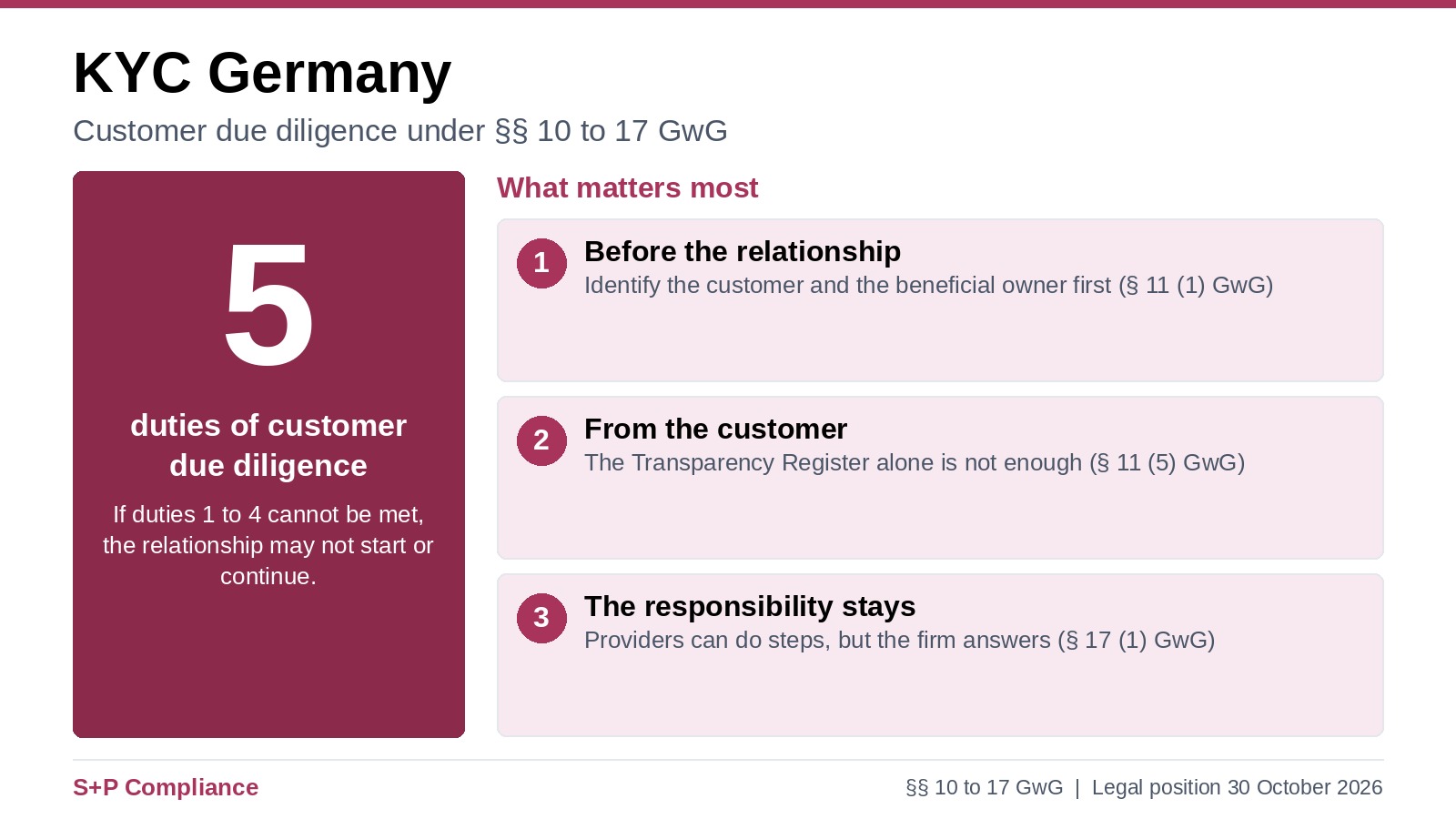
Five duties, then keep them current. § 10 (1) GwG lists them. If you cannot meet nos. 1 to 4, you may not establish or continue the relationship and may carry out no transaction (§ 10 (9) GwG).
01
The duties
Identify the customer, clarify the beneficial owner, obtain the purpose, check for PEPs and monitor the relationship continuously.
02
The timing
Identify before the relationship or transaction. Completion during establishment is possible only if it avoids interrupting normal business and the risk is low (§ 11 (1) GwG).
03
The beneficial owner
Collect the data from the customer. Taking them from the Transparency Register is not enough (§ 11 (5) GwG).
04
Providers
§ 17 (1) GwG lets you rely on third parties for duties nos. 1 to 4. The responsibility stays with you.
The duties are statutory, and the supervisor checks how you apply them. This overview helps if your head office is outside Germany and the German structures are new to you.
BaFin (the German Federal Financial Supervisory Authority, Bundesanstalt für Finanzdienstleistungsaufsicht) supervises banks and other financial firms. It can ask you to show that the scope of your measures is adequate (§ 10 (2) GwG).
The Transparency Register records the beneficial owners of legal entities. § 11 (5) GwG says that taking the data from the register is not enough to meet your duty to collect them.
The Financial Intelligence Unit (Zentralstelle für Finanztransaktionsuntersuchungen) receives suspicious activity reports (§ 43 GwG). Due diligence applies regardless of thresholds where facts point to money laundering (§ 10 (3) no. 3 GwG).
The EU Anti-Money Laundering Authority (AMLA) drafts technical standards for the EU Anti-Money Laundering Regulation (AMLR), among them the standards on customer due diligence.
The firm sets the procedures, applies them and answers for them, also where a provider collects or checks data.
The table shows the duties of § 10 GwG and the data that § 11 GwG asks for. The highlighted row is the one that is most often handled too lightly.
| Duty | What the GwG requires | Source |
|---|---|---|
| Identify the customer | Collect the name, place and date of birth, nationality and address of a natural person, or the firm name, legal form, register number, registered seat and the names of the representatives of a legal entity. Verify the data under § 12 GwG. | § 10 (1) no. 1, § 11 (4) GwG |
| Beneficial owner Often missed | Clarify whether the customer acts for a beneficial owner and identify them. If the customer is not a natural person, find out the ownership and control structure. Collect at least the first name and last name from the customer. The Transparency Register entry alone is not enough. | § 10 (1) no. 2, § 11 (5) GwG |
| Purpose | Obtain and assess information on the purpose and the intended nature of the relationship, unless it is clear from the relationship itself. | § 10 (1) no. 3 GwG |
| Politically exposed persons | Determine with appropriate, risk-based procedures whether the customer or the beneficial owner is a politically exposed person, a family member or a known close associate. | § 10 (1) no. 4 GwG |
| Ongoing monitoring | Monitor the relationship and its transactions continuously against what you know about the customer, the business and, where necessary, the source of assets. Keep documents and data up to date at appropriate intervals, based on risk. | § 10 (1) no. 5 GwG |
| Risk-based scope | The scope of the measures under nos. 2 to 5 must match the risk. You must show the supervisor, on request, that the scope is adequate. | § 10 (2) GwG |
| When | For every new customer, and for existing relationships at suitable times on a risk basis, in particular when relevant circumstances change. | § 10 (3a) GwG |
Key point
The register does not replace the question to the customer.
§ 11 (5) GwG says that the data on the beneficial owner are collected from the customer or the person acting for it. On our reading, the Transparency Register is a useful check of the answer, not its source.
Outside a relationship, the duties also apply to money transfers of EUR 1,000 or more, to other transactions of EUR 15,000 or more and to crypto transfers of EUR 1,000 or more. They apply regardless of thresholds where facts point to money laundering or terrorist financing, and where there are doubts about the identity data (§ 10 (3) GwG).
Chips in red mark steps that are still ahead.
Done. The current Geldwäschegesetz (GwG) is enacted. §§ 10 to 17 remain the base of customer due diligence in Germany.
Done. The EU Anti-Money Laundering Authority (AMLA) sends its final draft technical standards on customer due diligence to the Commission.
Open. The Commission decides whether to adopt the draft standards. AMLA proposes that they apply six months after entry into force. As far as we could verify on 30 October 2026, they have not yet been published in the Official Journal.
Open. The EU Anti-Money Laundering Regulation (AMLR) applies directly and has its own chapter on customer due diligence.
§ 10 (2) GwG. The scope of the measures under § 10 (1) nos. 2 to 5 must match the risk of money laundering or terrorist financing. You take into account the risk factors in Annexes 1 and 2 to the GwG and, at least, the purpose of the account or relationship, the amount of assets or the size of the transactions and the regularity or duration of the relationship. On request, you show the supervisor that the scope is adequate.
§ 11 (1) and (3) GwG. You identify before the relationship begins or before the transaction. If the risk is low, you can complete the identification without delay during the establishment, where this is needed to avoid interrupting normal business. A new identification is not needed if you identified the person earlier and recorded the data, unless there are doubts that the data are still correct.
§ 11 (6) GwG. The customer has duties as well. It provides the information and documents that you need, reports changes without delay and discloses whether it acts for a beneficial owner, with proof of the owner’s identity.
§ 10 (9) GwG. If you cannot meet the duties in § 10 (1) nos. 1 to 4, the relationship may not be established or continued and no transaction may be carried out. An existing relationship must be ended, whatever other statutory or contractual provisions say.
§ 17 GwG. You can rely on third parties for the duties in § 10 (1) nos. 1 to 4, and the responsibility for the due diligence stays with you (§ 17 (1) GwG). You cannot rely on a third party established in a high-risk third country (§ 17 (2) GwG). A transfer under a contract must not impair the fulfilment of your duties, the control of your management or the supervision (§ 17 (6) GwG). For banks, the rules on outsourcing under § 25b of the German Banking Act stay unaffected (§ 17 (9) GwG).
Higher risk. Enhanced due diligence under § 15 GwG applies in higher-risk cases, for example for politically exposed persons and for relationships that involve a high-risk third country.
EU rules. From 10 July 2027, the AMLR applies directly. In October 2026, AMLA sent the Commission its final draft technical standards on customer due diligence, which include rules on screening PEPs, family members and close associates. As far as we could verify on 30 October 2026, they are not yet adopted.
Different people carry different parts of the work. The split below follows the functions that usually exist in a German institution.
Approves the policy and the risk appetite and receives the reports. Approves PEP relationships (§ 15 (4) no. 1 GwG).
Sets the procedures, decides on difficult cases and keeps the evidence of the risk-based scope (§ 10 (2) GwG).
Collect and verify the data, clarify the beneficial owner and check for politically exposed persons.
Know the customer and the purpose of the relationship and report changes.
Collects or checks data under the contract and your procedures. It does not take over the responsibility.
You hand over the task, not the control. § 17 (1) GwG keeps the responsibility for the due diligence duties with the obliged firm, and § 17 (6) GwG bars transfers that impair its duties or its management’s control.
These six points recur where onboarding is designed for a group and then applied in Germany. They do not replace a review of your own set-up.
The register entry does not replace collecting the data from the customer.
§ 11 (5) GwG
Completion during establishment is possible only if it is needed for normal business and the risk is low.
§ 11 (1) GwG
Continuous monitoring and keeping data up to date are part of the duty.
§ 10 (1) no. 5 GwG
The scope must match the risk, and you must be able to show that it does.
§ 10 (2) GwG
A third party can help with the steps. The responsibility stays with the firm.
§ 17 (1) GwG
The GwG does not allow reliance on a third party established there. Check the exceptions for groups before you use one.
§ 17 (2) GwG
Select a status for each of the six questions. Nothing is stored or sent. The check is a self-assessment and does not replace legal advice.
These six steps build the evidence that your supervisor and your auditors ask for.
01
Check the order of steps against § 11 (1) GwG, so that identification comes before the start.
02
Ask the customer for the data, and use the Transparency Register as a check.
03
Document how risk factors change the scope of the measures, and test it.
04
Define intervals and triggers for refreshing data, by risk.
05
Keep a contract, a quality sample and the sign-off with your firm.
06
Track the Commission’s decision on the AMLA standards and plan the gap analysis.
Three key messages remain.
Identify, clarify the beneficial owner, understand the purpose, check for PEPs and monitor.
The scope must match the risk and be shown to the supervisor.
Providers can do steps. Your firm answers for the due diligence.
KYC Germany comes down to three records: what you collected and from whom, why the scope fits the risk and who decided. If you can show all three for each customer, the set-up holds up.
Where this sits in the S+P service model
Outsourced officer functions, including the Money Laundering Reporting Officer, bundled in the S+P Compliance Package.
Operational work, such as financial crime and customer operations, including KYC, carried out under your instructions.
Tools such as the S+P Compliance Cockpit that support both.
Officer functions and operational services are delivered separately, in organisation and in staffing.
The answers reflect the position on 30 October 2026 and do not replace legal advice in an individual case.
The GwG speaks of general due diligence duties, not of KYC. § 10 (1) GwG lists five: identify the customer, clarify the beneficial owner, obtain the purpose of the relationship, determine whether a politically exposed person is involved and monitor the relationship continuously. In practice, firms call this KYC.
Before the relationship or the transaction (§ 11 (1) GwG). Completion during establishment is possible if it is needed to avoid interrupting normal business and the risk is low. Outside a relationship, the duties apply to money transfers of EUR 1,000 or more, to other transactions of EUR 15,000 or more and to crypto transfers of EUR 1,000 or more. They also apply on facts that point to money laundering and on doubts about identity data (§ 10 (3) GwG).
No. § 11 (5) GwG says that data must be collected from the customer or the person acting for it, and that taking them from the Transparency Register is not enough. On our reading, the register is a useful check, not the source.
Partly. § 17 (1) GwG lets you rely on third parties for the duties in § 10 (1) nos. 1 to 4, and the responsibility stays with you. You cannot rely on a third party established in a high-risk third country (§ 17 (2) GwG), and the transfer must not impair your duties, the control of your management or the supervision (§ 17 (6) GwG). For banks, § 25b of the German Banking Act stays unaffected (§ 17 (9) GwG). Control, decision authority and final responsibility stay with your firm.
If you cannot meet the duties in § 10 (1) nos. 1 to 4, the relationship may not be established or continued and no transaction may be carried out. An existing relationship must be ended, whatever other provisions say (§ 10 (9) GwG). That decision stays with your firm.
S+P Compliance prepares and runs the operational work: collecting and checking identification data, ownership analysis, PEP and sanctions screening, reviews and quality checks. Stays with you: the risk appraisal, the decision to accept, refuse or end a relationship, the approval for PEP relationships and the report to the FIU under § 43 GwG. You hand over the task, not the control.
Only official German and EU bodies are linked.
§ 10 Geldwäschegesetz (German). General due diligence: the five duties (§ 10 (1)), risk-based scope (§ 10 (2)), timing (§ 10 (3), (3a)) and inability to comply (§ 10 (9)). gesetze-im-internet.de
§ 11 Geldwäschegesetz (German). Identification: timing (§ 11 (1)), data to collect (§ 11 (4), (5)) and the customer’s duties (§ 11 (6)). gesetze-im-internet.de
§ 17 Geldwäschegesetz (German). Reliance on third parties and contractual outsourcing of the due diligence duties. gesetze-im-internet.de
Regulation (EU) 2024/1624 (AMLR). The EU rules on customer due diligence. Application from 10 July 2027. eur-lex.europa.eu
AMLA press release, October 2026. Final draft technical standards on customer due diligence, including PEP screening, sent to the Commission. amla.europa.eu
BaFin: Interpretation and Application Guidance on the GwG, July 2025. The supervisor’s view on how the GwG is applied. PDF in English. bafin.de (PDF) [PDF]
Legal position on 30 October 2026. The AMLA standards are drafts until the Commission has adopted them and they are published in the Official Journal. Check the current text before you rely on it.
KYC touches several workstreams. These pages connect.
KYC and due diligence operations carried out under your procedures. Control, decision authority and final responsibility stay with your firm, and decisions on reports are not handed over.
The enhanced due diligence duties for politically exposed persons, including the approval that stays with the management.
The second trigger for enhanced due diligence in § 15 GwG: relationships that involve a listed country.
What Article 18 AMLR changes for outsourcing, including the six tasks that stay with your firm.
The service view for firms that look for an external Money Laundering Reporting Officer for their German entity. Responsibility stays with your firm.
Outsourced officer functions for institutions in Germany, bundled in one agreement.
We use cookies and similar technologies to improve your experience on our website. Read our Privacy Policy.