01
What it is
EBA/GL/2019/02
Guidelines of 25 February 2019 that apply since 30 September 2019. Authorities and institutions must make every effort to comply.
For EBA outsourcing guidelines, the text that applies today is EBA/GL/2019/02 of the European Banking Authority (EBA), which treats an arrangement as outsourcing when a provider performs something the institution would otherwise perform itself. It stays in place until the EBA’s new third-party risk guidelines apply, from a date that is not yet set.
Outsourcing must not hollow out the institution. The management body stays fully responsible, and outsourcing must not turn an institution into an empty shell (paras 35 and 39). Intragroup outsourcing follows the same framework as outsourcing outside the group.
01
What it is
Guidelines of 25 February 2019 that apply since 30 September 2019. Authorities and institutions must make every effort to comply.
02
The test
A provider performs a process, service or activity that the institution would otherwise perform itself, on a recurrent or ongoing basis (paras 12 and 26).
03
The focus
Critical or important functions get the heavy requirements. Outsourcing operational tasks of internal control functions counts, unless the assessment shows no adverse impact (para 29).
04
What replaces it
The EBA published the new guidelines on 18 September 2026. They repeal the 2019 text from a date that is not yet set, and a two-year transition follows.
The rules are an administrative circular on a statutory base. This overview helps if your head office is outside Germany and the German structures are new to you.
The European Banking Authority (EBA) issues the guidelines under Article 16 of Regulation (EU) No 1093/2010. They are addressed to supervisors and financial institutions.
BaFin (the German Federal Financial Supervisory Authority, Bundesanstalt für Finanzdienstleistungsaufsicht) supervises German institutions. It applies the EBA framework through its supervisory practice and the Minimum Requirements for Risk Management (MaRisk).
The Deutsche Bundesbank, the German central bank, publishes the MaRisk together with BaFin and takes part in the ongoing supervision of institutions.
The institution classifies its arrangements, keeps the register, informs the supervisor and stays responsible. The management body can never outsource its responsibility.
The provider performs the function under a written agreement that secures access, audit and termination rights. Intragroup providers are in scope as well.
The table summarises what the guidelines require. The highlighted row is the test that decides whether an arrangement is in scope.
| Topic | What the guidelines require | Source |
|---|---|---|
| Who applies them | Competent authorities, credit institutions and investment firms under the EU capital rules, payment institutions and e-money institutions. Authorities and institutions must make every effort to comply. | Paras 1 and 7 |
| The outsourcing test Core test | Would you do it yourself? An arrangement of any form by which a provider performs a process, a service or an activity that the institution would otherwise perform itself. Check whether it is recurrent or ongoing and whether institutions would normally or realistically perform the function, even if you never did. | Paras 12 and 26 |
| Not outsourcing, as a general principle | Statutory audit, market information services, global network infrastructures, clearing and settlement, correspondent banking, and services or goods that the institution would not otherwise undertake, such as legal opinions, cleaning and utilities. | Para 28 |
| Critical or important functions | Always where a failure would materially impair compliance, financial performance or soundness. Also when operational tasks of internal control functions are outsourced, unless the assessment shows no adverse impact, and for banking activities that need an authorisation. | Para 29 |
| Governance | The management body stays fully responsible. A written outsourcing policy, and an outsourcing function or a senior staff member who is directly accountable to the management body. | Paras 35 to 42 |
| Register and notification | A register of all outsourcing arrangements that distinguishes critical or important ones, available to the supervisor on request. Timely information on planned outsourcing of critical or important functions. | Paras 52 to 58 |
| Process and contract | Pre-outsourcing analysis, risk assessment and due diligence. A written agreement with more content for critical or important functions, covering sub-outsourcing, access and audit rights and termination. | Paras 61 to 93 |
Key point
Receiving services creates risk even when it is not outsourcing.
Paragraph 33 says that institutions must identify, assess, monitor and manage the risks of all arrangements with third parties, whether or not they are outsourcing. The stricter requirements apply to outsourcing, and above all to critical or important functions.
The paragraph numbers refer to the final report on EBA/GL/2019/02 of 25 February 2019. The EBA’s accompanying background text, which sets out the reasoning, is numbered separately.
Chips in red mark steps that are still ahead.
Done. The EBA publishes the final guidelines EBA/GL/2019/02.
Done. The guidelines apply to outsourcing arrangements entered into, reviewed or amended from this date. They repeal the 2006 guidelines and the cloud recommendation.
Done. The deadline passes for reviewing existing arrangements, for completing the documentation and for paragraph 63 (b) on cooperation agreements with third-country supervisors.
Done. The EBA publishes the final third-party risk guidelines EBA/GL/2026/09. They are not yet applicable.
Open. The new guidelines apply, and the 2019 guidelines are repealed from that date. As far as we could verify on 30 October 2026, no date has been set.
Legal nature. The EBA issued the guidelines under Article 16 of Regulation (EU) No 1093/2010. Competent authorities and financial institutions must make every effort to comply (para 1). They are addressed to competent authorities, to institutions under the EU capital rules, to payment institutions and to e-money institutions (para 7).
Outsourcing and what it is not. Outsourcing is an arrangement of any form by which a service provider performs a process, a service or an activity that the institution would otherwise perform itself (para 12). When testing an arrangement, institutions consider whether the function is performed on a recurrent or ongoing basis and whether it would normally or realistically be performed by institutions, even if the institution has not done it before (para 26). As a general principle, the following are not outsourcing: a function that the law requires a provider to perform, such as the statutory audit, market information services, global network infrastructures, clearing and settlement, correspondent banking, and services or goods that the institution would not otherwise undertake, for example legal opinions, cleaning, office supplies and utilities (para 28).
Critical or important functions. A function is always critical or important where a failure would materially impair the institution’s compliance with its authorisation, its financial performance or the soundness or continuity of its services. It is also critical or important when operational tasks of internal control functions are outsourced, unless the assessment shows that a failure would have no adverse impact on the control function’s effectiveness, and when banking activities are outsourced to an extent that needs an authorisation (para 29). Paragraph 31 lists factors for the assessment, among them substitutability and the ability to reintegrate the function.
Governance. Outsourcing cannot result in a delegation of the management body’s responsibilities (para 35). The institution needs a written outsourcing policy (paras 41 to 44). It establishes an outsourcing function or designates a senior staff member who is directly accountable to the management body. A small and less complex institution can assign the function to a member of the management body (para 38). Outsourcing must not turn the institution into an empty shell (para 39).
Register and notification. The institution keeps a register of all outsourcing arrangements that distinguishes critical or important functions from other arrangements (para 52), with the fields of paragraphs 54 and 55. It makes the register available to the supervisor on request, in a processable electronic form (para 56). It informs the supervisor in a timely manner of planned outsourcing of critical or important functions and of material changes and severe events (paras 58 and 59).
Process and contract. Before outsourcing, the institution assesses criticality, the supervisory conditions, the risks, the provider’s suitability and conflicts of interest (para 61). For third-country providers of banking activities, it needs a cooperation agreement between the supervisors (para 63). The written agreement covers the content of paragraph 75 for critical or important functions, rules on sub-outsourcing (paras 76 to 80) and access and audit rights (paras 85 to 93).
Replacement. The EBA published the final third-party risk guidelines (EBA/GL/2026/09) on 18 September 2026. They repeal the 2019 guidelines from a date of application that is not yet set, and a two-year transitional period follows. Until then, the 2019 guidelines remain in place.
Germany. The guidelines reach German institutions through BaFin’s supervision, § 25b of the German Banking Act (Kreditwesengesetz, KWG) and AT 9 of the MaRisk. On our reading, a service that AT 9 treats as other external procurement can still be a third-party arrangement that the EBA framework asks you to manage.
Different people carry different parts of the work. The split below follows the functions that usually exist in a German institution.
Approves and reviews the outsourcing policy and stays fully responsible, also for intragroup arrangements.
Is directly accountable to the management body and oversees the risks, the register and the documentation.
Report every recurrent or ongoing service so that it can be tested against the definition.
Support the criticality assessment, the risk assessment and the due diligence.
Reviews the outsourcing framework and the audit plan covers outsourcing of critical or important functions.
You hand over the task, not the control. The management body can never outsource its responsibility. It stays fully responsible and accountable, also for outsourcing within the group (paras 35 and 22).
These six points recur where outsourcing is managed as a contract list. They do not replace a review of your own set-up.
The new guidelines are final but not yet applicable. The 2019 guidelines stay in place until the date of application.
EBA/GL/2026/09
The test is whether a provider performs a function that the institution would otherwise perform, on a recurrent or ongoing basis. Size is not the test.
Paras 12 and 26
Outsourcing their operational tasks is critical or important, unless the assessment shows no adverse impact.
Para 29 (b)
The register must distinguish them and give a short reason.
Paras 52 and 54 (g)
The EBA says it is subject to the same framework as outsourcing outside the group, and it is not necessarily less risky.
Final report, background
Outsourcing must not leave an institution without the substance to remain authorised.
Para 39
Select a status for each of the six questions. Nothing is stored or sent. The check is a self-assessment and does not replace legal advice.
These six steps build the evidence that your supervisor and your auditors ask for.
01
List every recurrent or ongoing service and test it against the definition in paragraph 12.
02
Use the factors of paragraphs 29 to 31 and keep the reasons.
03
Cover all arrangements, flag the critical or important ones and add the fields of paragraph 55.
04
Designate the outsourcing function or the senior staff member who is directly accountable to the management body.
05
Compare contracts for critical or important functions with paragraph 75 and plan the changes.
06
Map the register and the policy against the new guidelines before the date of application is set.
Three key messages remain.
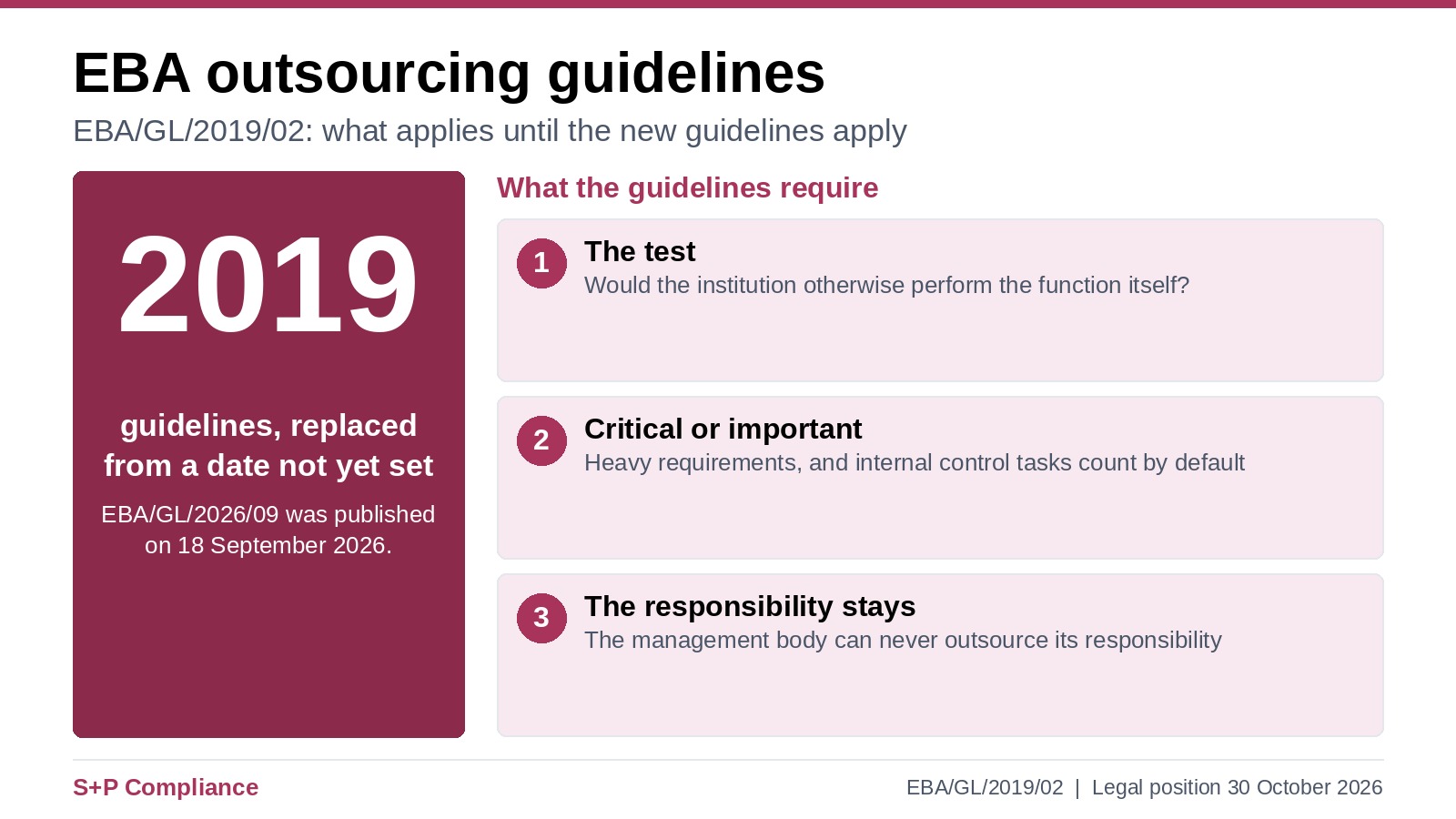
Would the institution otherwise perform it? Recurrent or ongoing performance matters.
Critical or important functions get the heavy requirements, and internal control tasks count by default.
The management body can never outsource its responsibility.
The EBA outsourcing guidelines come down to three records: why an arrangement is or is not outsourcing, why a function is or is not critical or important and what the register says. If you can show all three, the set-up holds up, today and under the new guidelines.
Where this sits in the S+P service model
Outsourced officer functions, including Internal Audit and Central Outsourcing Management, bundled in the S+P Compliance Package.
Operational work, such as securities, credit and reporting operations, carried out under your instructions.
Tools such as the S+P Compliance Cockpit that support both.
Officer functions and operational services are delivered separately, in organisation and in staffing.
The answers reflect the position on 30 October 2026 and do not replace legal advice in an individual case.
Yes. EBA/GL/2019/02 remain in place until the EBA’s new guidelines on third-party risk (EBA/GL/2026/09) apply. The EBA published the new text on 18 September 2026, and the date of application is not yet set. A two-year transitional period will support the implementation.
An arrangement of any form by which a service provider performs a process, a service or an activity that the institution would otherwise perform itself (para 12). Check whether the function is performed on a recurrent or ongoing basis and whether institutions would normally or realistically perform it (para 26). Some items are not outsourcing as a general principle, among them statutory audit and the purchase of services that the institution would not otherwise undertake (para 28).
Para 29 says always when a failure would materially impair compliance, financial performance or soundness, when operational tasks of internal control functions are outsourced, unless the assessment shows no adverse impact, and for banking activities that need an authorisation. Paragraph 31 lists the factors for the assessment.
Paragraph 54 lists the minimum for all arrangements, among them a reference number, dates, a description, the provider, the countries and whether the function is critical or important with a short reason. Paragraph 55 adds fields for critical or important functions, such as the governing law, the audit dates, sub-contractors, substitutability and the estimated annual cost.
They are addressed to supervisors and institutions. In Germany, they reach institutions through BaFin’s supervision, § 25b of the German Banking Act (Kreditwesengesetz, KWG) and AT 9 of the MaRisk. Control, decision authority and final responsibility stay with your firm. Check the circular’s list of the EBA guidelines it implements.
S+P Compliance prepares and runs the operational work: register building, criticality drafts, risk assessments, due diligence files, contract gap analyses and exit-plan drafts. Stays with you: the classification, the management body’s responsibility, the designation of the accountable person and the decision to outsource, renew or exit. You hand over the task, not the control.
Only official German and EU bodies are linked.
EBA Guidelines on outsourcing arrangements (EBA/GL/2019/02), final report. The text of the guidelines of 25 February 2019. PDF in English. eba.europa.eu (PDF) [PDF]
EBA press release of 18 September 2026. Final guidelines on third-party risk management and the two-year transitional period. eba.europa.eu
EBA: Guidelines on third-party risk management. Status page of the new guidelines. Final and awaiting translation into the official EU languages. eba.europa.eu
Circular 06/2026 (BA): Minimum Requirements for Risk Management (MaRisk) (German). The ninth amendment of 30 June 2026 with AT 9 on outsourcing. bafin.de
§ 25b Kreditwesengesetz (German). Outsourcing of activities and processes in German law. gesetze-im-internet.de
Legal position on 30 October 2026. The 2019 guidelines are replaced once the date of application of the new guidelines is set. Check the EBA status page before you rely on any date.
Outsourcing touches several workstreams. These pages connect.
Support for the outsourcing inventory, the register and the review cycle under your procedures. Classification and criticality decisions stay with your firm and are not handed over.
The service view for firms that look for an external Money Laundering Reporting Officer, a function whose outsourcing has its own rules. Responsibility stays with your firm.
Outsourced compliance function under the Minimum Requirements for Risk Management (MaRisk) for institutions in Germany. Decisions stay with your firm.
Independent reviews of outsourcing arrangements. Findings and follow-up decisions stay with your firm.
The overview for firms that move compliance work to Germany.
Outsourced officer functions for institutions in Germany, bundled in one agreement.
We use cookies and similar technologies to improve your experience on our website. Read our Privacy Policy.