Third-country branch Germany: what CRD VI requires from 2027
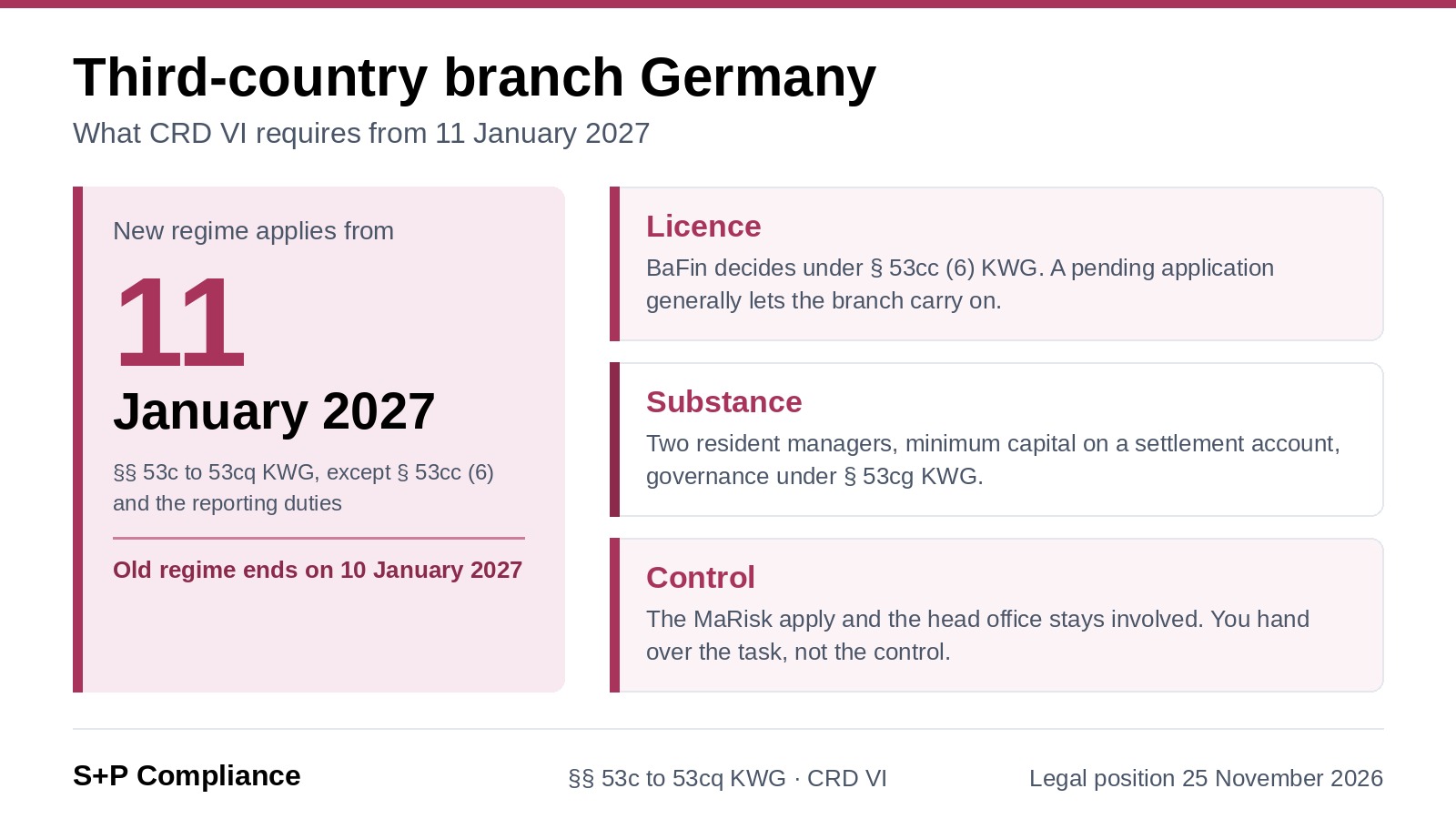
The third-country branch Germany regime under CRD VI (the sixth Capital Requirements Directive, Directive (EU) 2024/1619) applies from 11 January 2027, and BaFin (the German Federal Financial Supervisory Authority) is relicensing existing branches under it. This article shows what your branch needs in place, what stays with your managers and what an external provider can take over.
BaFin decides, not the calendar. Existing authorisations continue only if BaFin so decides under § 53cc (6) KWG (German Banking Act, Kreditwesengesetz), and an application that is still pending on 10 January 2027 generally lets the branch carry on as before.
Management summary: four points
What the new regime means for your branch, in short.
Core banking services need a licensed branch
From 11 January 2027, §§ 53c to 53cq KWG apply to branches of undertakings seated outside the EU that take deposits, grant credit or give guarantees in Germany (§ 53c (1) KWG). Pure investment services under Annex I Section A of Directive 2014/65/EU are carved out. The reporting duties in § 53ck and § 53cl are not deferred (§ 64c (5) KWG).
BaFin takes one decision per branch
Existing branches under § 53 KWG do not switch over automatically. BaFin issues one decision that revokes the old authorisation and grants the new one (§ 53cc (6) KWG), if the branch meets §§ 53ca to 53cq. A self-assessment questionnaire (SAQ) that is already submitted counts as the application.
Capital, account and two managers
The branch holds minimum capital of 2.5% or 0.5% of average liabilities on a settlement account, appoints two managing directors resident in Germany and meets the governance rules of § 25a (1) KWG and § 53cg KWG.
MaRisk (Minimum Requirements for Risk Management) and outsourcing
The MaRisk apply to the branch (module AT 2.1). Compliance, risk control and internal audit must exist. On our reading, a very small branch may outsource compliance or internal audit completely (AT 9 no. 5), and control stays with your managers.
Who does what in Germany
If your head office sits outside Germany, the German roles below are the ones you meet first.
Grants the licence (§ 53cc KWG), decides whether an existing authorisation continues (§ 53cc (6) KWG) and can ask a branch to apply for a licence as a subsidiary (§ 53ci KWG).
The German central bank. It works alongside BaFin: it is notified of risk class changes (§ 53ca (4) KWG) and needs unrestricted access to information on outsourcing (§ 53cg (5) KWG).
Must be told about the application and shown the business plan. BaFin must be able to obtain all necessary information from it, also in a crisis (§ 53cc (4) nos. 3 and 4 KWG).
German term: Kopfunternehmen. The third-country company that set up the branch, plus intermediate and ultimate parents where applicable (§ 53c (2) KWG). The branch reports to its management body on all material risks (§ 53cg (4) KWG).
German term: Geschäftsleiter. Two natural persons resident in Germany, authorised to manage and represent the branch and entered in the commercial register (§ 53cg (1) KWG). BaFin holds them responsible for choosing the settlement account.
German term: Jahresabschlussprüfer. Assesses every year how the governance, risk management and outsourcing requirements are implemented and reports to BaFin and the Bundesbank (§ 53cg (8) KWG).
What the third-country branch Germany regime covers
At EU level, Article 21c of Directive 2013/36/EU, inserted by CRD VI, makes the core banking services in points 1, 2 and 6 of Annex I (deposits, lending, guarantees and commitments) subject to an explicit authorisation requirement. Germany implemented this through the BRUBEG (the German CRD VI Implementation Act, Bankenrichtlinienumsetzungs- und Bürokratieentlastungsgesetz), promulgated on 30 March 2026, which put the new §§ 53c to 53cq into the KWG from 1 April 2026. Our source for the EU rule is Directive (EU) 2024/1619 on EUR-Lex (see Sources).
A branch falls under the new regime (a “CRD third-country branch”) in two cases. Either the undertaking would be a credit institution under the Capital Requirements Regulation (CRR) if it were seated in the EU and the branch carries out lending or guarantee activities (Annex I no. 2 or no. 6), or the branch takes deposits (Annex I no. 1). Both cases are set out in § 53c (1) KWG. Branches that only provide investment services under Annex I Section A of Directive 2014/65/EU, or ancillary services to them, are excluded.
The licence is national. The branch may carry out the licensed activities only in Germany (§ 53cc (5) KWG), with two exceptions: intragroup financing with other CRD third-country branches of the head undertaking, and services obtained at the exclusive initiative of the client or counterparty. BaFin must state this limit in the licence notice. There is no passport into other Member States.
This article covers branches that exist or are planned. Whether a bank without a branch may keep serving German clients is a separate question that we do not assess here.
Risk classes decide how heavy the requirements are
Every branch is sorted into risk class 1 or 2, and a few conditions decide it (§ 53ca KWG). A “qualified” branch under § 53cb KWG needs, among other conditions, home-country supervision at least equal to the EU standard. In some cases the European Commission must first assess the home country, and until it has, the branch counts as class 1. Whether the home country is on the EU list of high-risk third countries also matters; our article on the high-risk third countries list explains that list.
| Topic | Risk class 1 | Risk class 2 | Norm |
|---|---|---|---|
| Trigger | At least EUR 5 billion of assets booked or initiated in Germany, or retail deposits of at least 5% of total liabilities or above EUR 50 million, or the branch is not a qualified branch | None of the class 1 triggers applies | § 53ca (1), (2) KWG |
| Minimum capital | 2.5% of average liabilities of the last three annual reporting periods, at least EUR 10 million | 0.5% of average liabilities of the last three annual reporting periods, at least EUR 5 million | § 53ce (1) KWG |
| Management committee in Germany | BaFin can require one | Not mentioned for class 2 | § 53cg (2) KWG |
| Combining risk control and compliance with other functions Outsourcing | No such option in the class 1 rules | Possible if no material conflicts of interest arise. BaFin can require full compliance depending on size, organisation and complexity | § 53cg (2), (3) KWG |
| MaRisk size class Outsourcing | No automatic relief from the class itself | Counts as a “small institution”. A branch of any class is “very small” if its four-year average total assets stay at or below EUR 1 billion | MaRisk AT 1 no. 3 |
Class 2 gives room on structure, not on responsibility. On our reading, a class 2 branch can run risk control and compliance lean, and a very small branch can outsource compliance or internal audit completely, but its two resident managers stay responsible for the functions.
Key dates and where things stand
Three dates matter for planning: the old regime ends on 10 January 2027, the new one starts on 11 January 2027, and the settlement account guidance runs to the end of 2027.
- 11 January 2026
Done: § 53c (1) KWG applies for the purposes of the reporting duties in § 53ck and § 53cl (§ 64c (5) sentence 2 KWG).
- 30 March 2026
Done: The BRUBEG is promulgated (see the BaFin supervisory statement, footnote 1).
- 1 April 2026
Done: §§ 53c ff. are part of the KWG. Most of them apply later.
- 18 November 2026
Done: BaFin publishes Supervisory Statement 10/2026 (BA) on the relicensing procedure and on settlement accounts.
- 10 January 2027
Open: Last day of the old regime. Authorisations granted up to this date can continue by BaFin decision (§ 53cc (6) KWG). A pending application generally lets the branch carry on as before.
- 11 January 2027
Open: §§ 53c to 53cq KWG apply, except § 53cc (6) and §§ 53ck and 53cl (§ 64c (5) KWG).
- 31 December 2027
Open: Section 3 of the supervisory statement (settlement accounts) applies until this date. BaFin may later move its content into a circular.
What the rules require, by function
The KWG sets the frame and the MaRisk fill it. Both address the same six places in your branch.
Head undertaking
It sets reporting lines to its management body for all material risks and risk management policies. Where it performs critical or important functions of the branch, it does so in line with branch or group rules and gives BaFin and the Bundesbank access to all information. The MaRisk have no supervisory body to address in a branch, so the head office is involved “in an appropriate form” (AT 1).
Two resident managers
They carry the overall responsibility for proper business organisation (AT 3.1 no. 1), set the business and risk strategy (AT 4.2) and, according to BaFin, are responsible for choosing and contracting the settlement account (Supervisory Statement 10/2026 (BA), no. 10).
Compliance function
Every institution needs one, with a named compliance officer (nos. 1 and 4). It reports to management at least once a year (no. 6) and can be combined with other suitable functions (no. 3). A class 2 branch may also combine it with risk control (§ 53cg (3) sentence 2 KWG).
Risk control function
It monitors and reports material risks and is separate from units that initiate business up to management level (no. 1). For third-country branches, a deviation is possible if the separation of responsibilities still follows the principle up to managing-director level (MaRisk module BTO, no. 3).
Internal audit
It must work, be independent and report directly to management (nos. 1 and 2). In principle it reviews all activities, including outsourced ones, within three years (no. 6) and reports to management every quarter (no. 9).
Outsourcing and ICT (information and communication technology)
The branch monitors and manages its outsourcing arrangements and gives BaFin and the Bundesbank unrestricted access. Depending on scale it sets up central outsourcing management with an outsourcing register (AT 9 nos. 12 and 13). It applies Article 16 of DORA (Digital Operational Resilience Act, Regulation (EU) 2022/2554), the simplified ICT risk management framework (§ 53cg (4) sentence 2 KWG).
Which cybersecurity regime applies: two paths
§ 28 (6) no. 1 of the BSIG (German Act on the Federal Office for Information Security, BSI-Gesetz) excludes two groups from its core obligations (§§ 30, 31, 32, 35, 36, 38 and 39 BSIG): financial entities under Article 2 (2) DORA, and undertakings to which DORA applies by virtue of §§ 1a (2) and (2a) of the KWG. A branch whose ICT duties follow DORA sits on the DORA path. Other German group entities that are not financial entities, for example an ICT service company, can sit on the BSIG path if they reach the size thresholds in § 28 (1) and (2) BSIG.
Whether a third-country branch is a financial entity under Article 2 (2) DORA is not settled by the provisions we read. On our reading, § 53cg (4) KWG places the branch on the DORA path, not yet confirmed by supervisory guidance. Please check this for your own structure.
What stays with your firm
Taking over tasks is possible. Taking over responsibility is not.
Stays with your firm
- Answering and submitting the relicensing questionnaire (§ 53cc (6) KWG)
- Appointing the two resident managers and registering them (§ 53cg (1) KWG)
- Choosing and contracting the settlement account (Supervisory Statement 10/2026 (BA), no. 10)
- Strategies, risk appetite and the decision to outsource (MaRisk AT 3.1, AT 4.2, AT 9 no. 4)
- Appointing the independent officer where a function is fully outsourced (AT 9 no. 10)
- Financial-crime decisions: suspicious activity reports to the FIU (Germany’s Financial Intelligence Unit) under § 43 GwG (German Anti-Money Laundering Act, Geldwäschegesetz), sanctions blocks, approval of scenarios and thresholds, senior management approval under § 15 (5) no. 2 GwG, and discrepancy reports to the Transparency Register (the German register of beneficial owners)
A provider can prepare and run
- Gap analysis against §§ 53ca to 53cq KWG and the questionnaire, with an evidence file
- Drafting policies, procedures and the MaRisk documentation of the branch (AT 5)
- Running monitoring and testing in the compliance function on your instructions
- Providing the officer role for compliance or internal audit where full outsourcing is permitted (AT 9 nos. 5 and 10)
- Keeping the outsourcing register and preparing the report on material outsourcing (AT 9 nos. 12 and 13)
- Preparing reports and evidence for the auditor, BaFin and the Bundesbank
You hand over the task, not the control.
Six pain points for a German branch
These are the points where branches most often need more time than planned.
The questionnaire reads like an application
BaFin treats a submitted questionnaire as the application. Check each answer against how the branch actually operates before it goes in.
Two managers, both resident and registered
One local manager, or managers abroad, do not meet the rule. It requires two natural persons resident in Germany, with authority to manage and represent, entered in the commercial register.
A settlement account without a checklist
BaFin will not publish a catalogue of criteria. It judges against the principle that the deposited instruments are available for liquidation and resolution. A legal opinion helps in the procedure but does not bind the auditor or BaFin later.
Capital that moves with liabilities
Capital is 2.5% or 0.5% of three-year average liabilities. A class 1 branch that no longer meets a trigger moves to class 2 at once. A class 2 branch that meets one moves to class 1 after four months, and must tell BaFin and the Bundesbank without delay (§ 53ca (3), (4)).
Control functions without a supervisory body
The head office has to be involved in place of a supervisory body. Your branch must show how compliance, risk control and internal audit work, report and stay free of conflicts.
Outsourcing and ICT at the same time
The branch needs an outsourcing register, access rights for BaFin and the Bundesbank, and the simplified ICT framework under Article 16 DORA. The auditor assesses all of this every year.
Quick check: how ready is your branch?
Answer six questions. Each answer shows a traffic light and a recommendation. Nothing is stored or sent.
Six no-regret measures before 11 January 2027
These steps help whatever BaFin decides, and they take little time to start.
Check the questionnaire against reality
Match each answer to a document, an owner and a date. Submit only what the branch can show on the day of an inspection.
Settle the manager structure
Name the two resident managers, file the register entries and write down who is responsible for what, as AT 5 no. 3 expects.
Choose and document the settlement account
Select the account, agree the contract, obtain the legal opinion and limit access to the two managers and the persons they name.
Build a risk class and capital watch
Track assets, retail deposits and the class status, and plan the capital for the four-month rule and for growth.
Map the MaRisk to your branch
Decide for compliance, risk control and internal audit what is run in-house and what is outsourced. Where a function is fully outsourced, the managers appoint an independent officer. Control, decision authority and final responsibility stay with your firm.
Tidy up outsourcing and ICT
Complete the outsourcing register, check access rights in every contract and decide which cybersecurity path applies to each German entity.
Conclusion: licence, substance and control
The licence runs on a decision
Existing authorisations continue only by BaFin decision. A pending application generally lets the branch carry on.
Substance sits in Germany
Two resident managers, minimum capital, a settlement account and MaRisk-compliant control functions are the core of the file.
Tasks can move, control cannot
A provider can prepare and run tasks. Decision authority and final responsibility stay with your managers.
The third-country branch Germany regime rewards early preparation. The time between now and 11 January 2027 is best spent on the questionnaire, the manager structure, the settlement account and the control functions. S+P Compliance can prepare and run the tasks around them, and you keep the control.
Compliance as a Service
Outsourced officer functions such as Compliance Officer, MaRisk Compliance Officer, Internal Audit and Central Outsourcing Management, bundled in the S+P Compliance Package.
1st Line Services
Operational processing to your instructions, in four clusters, among them Financial Crime & Customer Operations and Outsourcing & Third-Party Operations.
RegTech
S+P Compliance Cockpit, KYC as a Service, Compliance Monitoring (S+P IntegrityMonitoring) and the Whistleblowing system (S+P IntegrityWatch).
FAQ
Six questions we hear most from branch managers and heads of compliance.
Does every bank from outside the EU need a branch in Germany from 11 January 2027?+−
No. The branch regime concerns undertakings that provide the core banking services in § 53c (1) KWG (deposits, lending or guarantees) in Germany on a commercial scale (§ 53cc (1) KWG), and investment services under Annex I Section A of Directive 2014/65/EU are excluded. This article covers branches only. Whether a bank without a branch may keep serving German clients is a separate question that we do not assess.
Is 10 January 2027 a hard deadline for the relicensing?+−
Not in the way it is often described. BaFin reads § 53cc (6) KWG as having no automatic effect and will decide each case in one decision. If an application is still undecided at the end of 10 January 2027, carrying on as before is generally treated as permitted, unless proceedings to withdraw the old authorisation were opened earlier (Supervisory Statement 10/2026 (BA), no. 8).
Which risk class will our branch be in?+−
Class 1 applies from EUR 5 billion of assets booked or initiated in Germany, with retail deposits of at least 5% of liabilities or above EUR 50 million, or if the branch is not a qualified branch. Every other branch is class 2 (§ 53ca KWG).
Do the MaRisk apply to a third-country branch?+−
Yes. Module AT 2.1 of the MaRisk of 30 June 2026 expressly covers CRD third-country branches. The head office is involved in place of a supervisory body, and class 2 branches count as small institutions.
Can we outsource the compliance function or internal audit of our branch?+−
On our reading, yes, within limits. AT 9 no. 5 allows outsourcing in control areas to the extent that effective oversight stays possible, and full outsourcing of compliance or internal audit for very small institutions, which include branches with four-year average total assets up to EUR 1 billion. The managers then appoint an independent officer (AT 9 no. 10). This is not yet confirmed by supervisory guidance for branches. You hand over the task, not the control.
Does DORA or the BSIG apply to our branch?+−
The branch applies Article 16 DORA under § 53cg (4) KWG. § 28 (6) BSIG excludes financial entities from its core obligations, so a branch on the DORA path is not covered by the BSIG duties on our reading. German group entities that are not financial entities can fall under the BSIG if they meet its size thresholds.
Sources
Only official bodies are linked. Secondary commentary was used for reading only.
EU law
Directive (EU) 2024/1619 (CRD VI), EUR-Lex
The EU basis: core banking services and third-country branches.
German statutes
§ 53c KWG (German)
Scope: which branches are CRD third-country branches.
§ 53ca KWG (German)
Risk class 1 and class 2, class changes and the duty to notify.
§ 53cc KWG (German)
Authorisation, conditions, territorial limit and continuation of existing authorisations.
§ 53ce KWG (German)
Minimum capital and settlement account.
§ 53cg KWG (German)
Resident managers, governance, outsourcing, ICT and annual audit.
§ 53ci KWG (German)
BaFin’s power to require a licence as a subsidiary.
§ 64c KWG (German)
Transitional rule: application from 11 January 2027.
§ 53 KWG (German)
The current rule for branches of foreign undertakings.
§ 28 BSIG (German)
Exclusion of financial entities and the two cybersecurity paths.
Supervisory guidance
BaFin Supervisory Statement 10/2026 (BA) (German)
Relicensing procedure and expectations on settlement accounts, 18 November 2026.
MaRisk circular 06/2026 (BA) of 30 June 2026 (German) [PDF]
Scope for third-country branches, control functions and outsourcing.
German statutes and circulars are the binding versions. We found no official English version of the BaFin statement or the MaRisk and cite the German texts. This article is general information and not legal advice. Legal position as of 25 November 2026.
Related services and programmes
Where S+P Compliance can take over tasks around the new regime.
Outsourcing compliance officer
Take over the compliance function for your German branch, with control staying at your firm.
Outsourcing MaRisk compliance officer
The officer role under the MaRisk, run by S+P Compliance.
Internal audit outsourcing
Independent internal audit for institutions that cannot staff it in Germany.
Outsourcing management in Germany
Central outsourcing management and the outsourcing register.
What S+P Compliance can take over for your operations in Germany.
Seminars and training
Training for managers and compliance teams on the S+P courses site.