01
The duty
Every institution
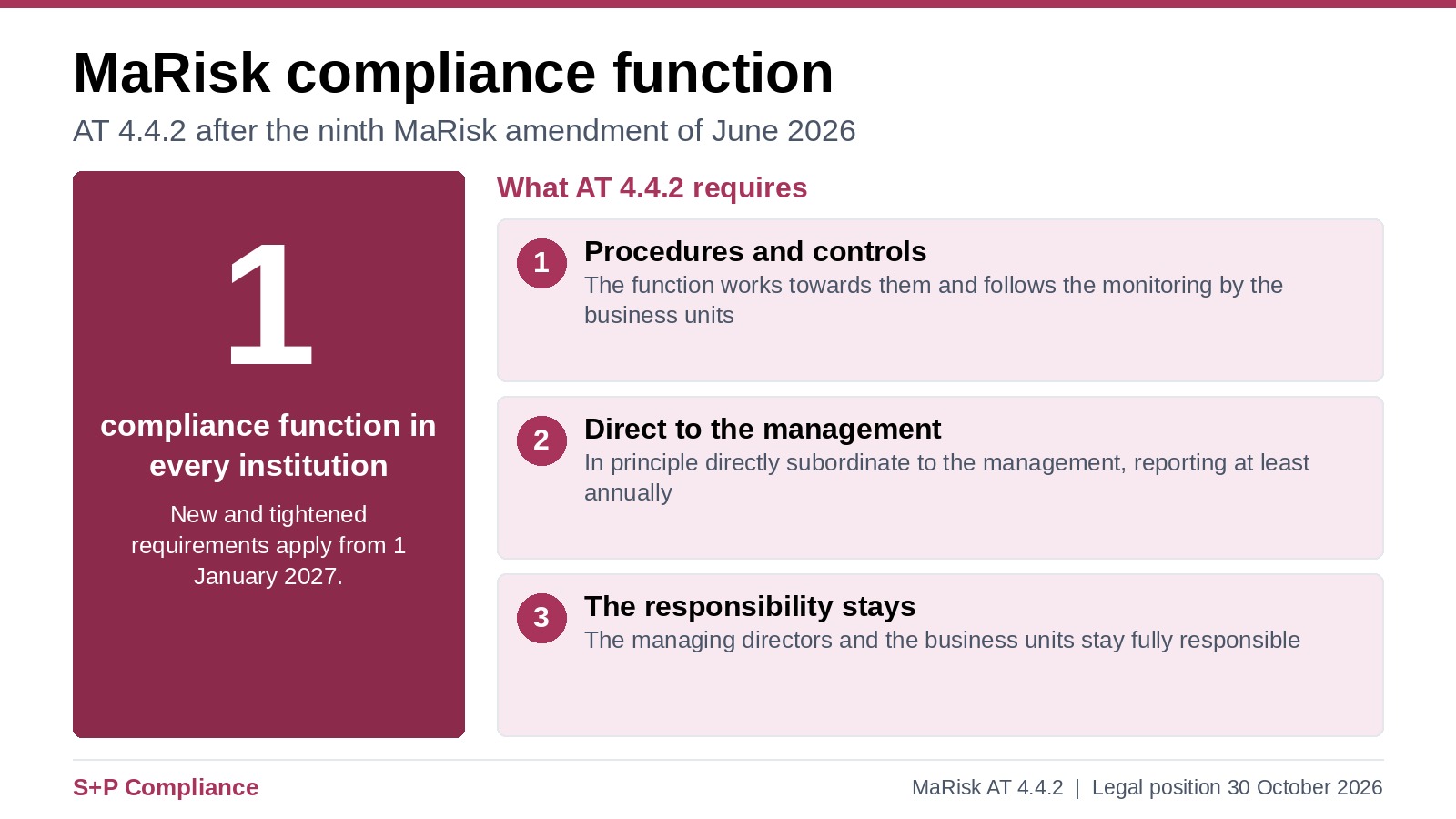
AT 4.4.2 no. 1 requires every institution to have a compliance function. It supports and advises the management and works towards procedures and controls.
The MaRisk compliance function in AT 4.4.2 of the German Minimum Requirements for Risk Management (MaRisk) works towards effective procedures and controls for the legal rules that matter to a bank, and since the ninth amendment of 30 June 2026 it also follows a structured process in which the business areas monitor compliance. The managing directors and the business units stay fully responsible.
Procedures and controls, not only advice. AT 4.4.2 no. 1 requires every institution to have a compliance function. It is directly subordinate to the management in principle, reports at least annually, and the responsibility stays with the managing directors and the business units.
01
The duty
AT 4.4.2 no. 1 requires every institution to have a compliance function. It supports and advises the management and works towards procedures and controls.
02
The 2026 change
The function must ensure, in a structured process, that the affected areas monitor compliance with the material legal rules. New and tightened requirements apply from 1 January 2027.
03
The position
In principle directly subordinate to the management. Attachment to another control unit is possible with a direct reporting line.
04
The responsibility
The managing directors and the business units stay fully responsible for compliance with the legal rules.
The rules are an administrative circular on a statutory base. This overview helps if your head office is outside Germany and the German structures are new to you.
BaFin (the German Federal Financial Supervisory Authority, Bundesanstalt für Finanzdienstleistungsaufsicht) issues the MaRisk circular for banks and supervises how institutions apply AT 4.4.2.
The Deutsche Bundesbank, the German central bank, publishes the MaRisk together with BaFin and takes part in the ongoing supervision of institutions.
The managing directors stay responsible for compliance with the legal rules. They receive the compliance report and decide on the measures.
The function works towards procedures and controls, identifies the material legal rules and reports. The compliance officer heads it.
The business units stay fully responsible for compliance with the legal rules in their area and monitor it, in a process that the compliance function can follow.
The table shows what AT 4.4.2 asks of the compliance function. The highlighted row is the change that matters most in 2026.
| Topic | What AT 4.4.2 says | Source |
|---|---|---|
| Existence | Every institution needs a compliance function. | AT 4.4.2 no. 1 |
| Task New in 2026 | Procedures and controls Work towards effective procedures and controls for the legal rules that are material for the institution, and support and advise the management. The 2026 text adds a structured process in which the affected areas monitor compliance. | AT 4.4.2 nos. 1 and 2 |
| Responsibility | The managing directors and the business units stay fully responsible for compliance with the legal rules. | AT 4.4.2 |
| Position | In principle directly subordinate to the management and reporting to it. Attachment to another control unit is possible if a direct reporting line exists. | AT 4.4.2 no. 3 |
| Compliance officer | Heads the function. A very small institution can assign the role to a managing director under the conditions of the circular. | AT 4.4.2 no. 4 |
| Resources | Sufficient powers and resources. Instructions and decisions of the management that matter to the function are communicated to it. | AT 4.4.2 |
| Reporting | At least annually and when needed, to the management, covering the adequacy and effectiveness of the rules. | AT 4.4.2 |
Key point
The function follows the monitoring. It does not replace it.
The business units stay fully responsible for compliance in their area. The compliance function makes sure, in a structured process, that they monitor it, and it works towards the procedures and controls.
Other supervisory regimes have their own compliance duties, for example for securities services and for money laundering prevention. The explanation to AT 4.4.2 addresses the relationship to other supervisory requirements. This article follows the MaRisk circular for banks, Circular 06/2026 (BA).
Chips in red mark steps that are still ahead.
Done. The previous MaRisk (Circular 06/2024 (BA)) applies.
Done. BaFin consults on the draft of the ninth MaRisk amendment (Consultation 02/2026).
Done. BaFin publishes Circular 06/2026 (BA). It enters into force on publication. Reliefs apply from then.
Open. New and tightened requirements apply after the transition period.
AT 4.4.2 no. 1. Each institution needs a compliance function to counter the risks that can arise from non-compliance with legal rules. The function works towards effective procedures for complying with the legal rules that are material for the institution, and towards the corresponding controls. It supports and advises the management.
AT 4.4.2 no. 2. The compliance function identifies the material legal rules, whose breach could endanger the institution’s assets, at regular intervals and under risk aspects. The 2026 text adds that it identifies the risks from non-compliance with the material rules and ensures, in a structured process, that the affected areas monitor compliance.
Responsibility. The managing directors and the business units stay fully responsible for compliance with the legal rules, whatever the compliance function does.
AT 4.4.2 no. 3. In principle, the compliance function is directly subordinate to the management and reports to it. It can be attached to another control unit if a direct reporting line to the management exists. To perform its tasks, it can draw on other functions and units. It works with the risk controlling function and exchanges information with it.
AT 4.4.2 no. 4. The compliance officer heads the function. In a very small institution, a managing director can take the role under the conditions of the circular. Very small institutions are those with a balance sheet total of up to EUR 1 billion on a four-year average.
Resources and reporting. The staff of the function need sufficient powers and resources, and instructions and decisions of the management that matter to the function are communicated to them. The function reports to the management at least annually and when needed, and covers the adequacy and effectiveness of the rules.
Outsourcing. Full outsourcing of the compliance function is limited by AT 9 no. 5, and § 25b of the German Banking Act (Kreditwesengesetz, KWG) keeps the responsibility of the managing directors with the institution.
The circular entered into force on 30 June 2026. New and tightened requirements apply after the transition period, from 1 January 2027, according to BaFin’s transmittal letter.
Different people carry different parts of the work. The split below follows the functions that usually exist in a German institution.
Appoints the compliance officer, gives the function powers and resources and receives the report. Stays responsible.
Heads the function, coordinates the identification of material legal rules and reports to the management.
Monitor compliance with the rules in their area and report to the compliance function.
Works with the compliance function and exchanges information with it.
Reviews the compliance function independently as part of its audit plan.
You hand over the task, not the control. The managing directors and the business units stay fully responsible for compliance, and § 25b (2) KWG keeps the responsibility of the managing directors with the institution.
These six points recur where the compliance function is set up as an advisory unit. They do not replace a review of your own set-up.
The managing directors and the business units stay fully responsible. The function works towards procedures and controls.
AT 4.4.2
The task is procedures and controls, and the 2026 text adds a structured process in which the affected areas monitor compliance.
AT 4.4.2 nos. 1 and 2
The function is in principle directly subordinate to the management and reports to it.
AT 4.4.2 no. 3
Every institution needs a compliance function. On our reading, group compliance can support it, but does not replace it.
AT 4.4.2 no. 1
The report covers the adequacy and effectiveness of the rules, not only the activities.
AT 4.4.2
New and tightened requirements apply after the transition period on 1 January 2027.
Circular 06/2026 (BA)
Select a status for each of the six questions. Nothing is stored or sent. The check is a self-assessment and does not replace legal advice.
These six steps build the evidence that your supervisor and your auditors ask for.
01
Document the compliance function, the compliance officer and the reporting line to the management.
02
Identify the material legal rules under risk aspects and refresh the list at set intervals.
03
Define how the business units monitor compliance and how the function follows it.
04
Document powers, resources and the information flow from the management.
05
Assess adequacy and effectiveness and list deficiencies and measures.
06
Compare AT 4.4.2 with your set-up and assign the actions.
Three key messages remain.
The function works towards procedures and controls and follows the monitoring of the business units.
The managing directors and the business units stay fully responsible.
The report covers adequacy and effectiveness, at least annually and when needed.
The MaRisk compliance function comes down to three records: which legal rules are material and why, how the business units monitor them and what the report says about adequacy and effectiveness. If you can show all three, the set-up holds up.
Where this sits in the S+P service model
Outsourced officer functions, including Internal Audit and Central Outsourcing Management, bundled in the S+P Compliance Package.
Operational work, such as securities, credit and reporting operations, carried out under your instructions.
Tools such as the S+P Compliance Cockpit that support both.
Officer functions and operational services are delivered separately, in organisation and in staffing.
The answers reflect the position on 30 October 2026 and do not replace legal advice in an individual case.
AT 4.4.2 MaRisk requires every institution to have a compliance function. It works towards effective procedures and controls for the legal rules that are material for the institution, and it supports and advises the management. The managing directors and the business units stay fully responsible for compliance.
BaFin published Circular 06/2026 (BA) on 30 June 2026. For the compliance function, the text now asks for a structured process in which the affected areas monitor compliance, and it names controls more clearly. New and tightened requirements apply after the transition period on 1 January 2027.
In principle directly to the management (AT 4.4.2 no. 3). The function can be attached to another control unit if a direct reporting line to the management exists. It reports at least annually and when needed.
No. The MaRisk compliance function covers the legal rules that are material for the institution. The money laundering reporting officer is a separate role with its own rules in § 7 GwG (German Anti-Money Laundering Act, Geldwäschegesetz). Commentary on the new circular reads the explanation as restricting the combination of the money laundering and data protection roles. We have not checked that wording, so read the explanation itself.
Under AT 9 no. 5, a full outsourcing of the compliance function is possible for subsidiary institutions within a group if the outsourcing institution is not material, and for very small institutions. Partial outsourcing follows the special standards of AT 9 no. 4. Control, decision authority and final responsibility stay with your firm.
S+P Compliance prepares and runs the operational work: risk analyses of the legal rules, monitoring plans, control tests, draft reports and training material. Stays with you: the responsibility for compliance, the appointment of the compliance officer, the decisions on resources and the response to the compliance report. You hand over the task, not the control.
Only official German and EU bodies are linked.
Circular 06/2026 (BA): Minimum Requirements for Risk Management (MaRisk) (German). The ninth amendment of 30 June 2026. AT 4.4.2 on the compliance function and AT 9 on outsourcing. bafin.de
MaRisk text of Circular 06/2026 (BA), PDF (German). The full text of AT 4.4.2 and its explanations. bafin.de (PDF) [PDF]
BaFin transmittal letter of 30 June 2026 (German). Entry into force on publication and the transition period until 1 January 2027. bundesbank.de (PDF) [PDF]
§ 25b Kreditwesengesetz (German). Outsourcing of activities and processes: precautions, responsibility and agreement. gesetze-im-internet.de
§ 7 Geldwäschegesetz (German). The money laundering reporting officer, a separate role from the MaRisk compliance function. gesetze-im-internet.de
Legal position on 30 October 2026. MaRisk is an administrative circular and BaFin can amend it. Check the current text before you rely on it.
The compliance function touches several workstreams. These pages connect.
The service view: an outsourced compliance function under the Minimum Requirements for Risk Management (MaRisk). Control, decision authority and final responsibility stay with your firm, and the responsibility for compliance is not handed over.
The service view for securities services compliance under the German Securities Trading Act. Decisions stay with your firm.
The overview of the compliance officer service for firms in Germany. Responsibility stays with your firm.
The service view for firms that look for an external Money Laundering Reporting Officer. Responsibility stays with your firm.
What Article 18 of the EU Anti-Money Laundering Regulation (AMLR) changes for outsourcing, including the six tasks that stay with your firm.
Outsourced officer functions for institutions in Germany, bundled in one agreement.
We use cookies and similar technologies to improve your experience on our website. Read our Privacy Policy.