Each trend below keeps its original logic. What is new is the question we put to it: what does it mean for the German branch, and who owns the answer?
1Digital transformation and artificial intelligence
What changes. Artificial intelligence, automation and data-driven decisions move from IT projects to management topics. Decision-makers need enough data competence to challenge what the models produce.
For your German branch. Decide who owns the use of artificial intelligence for the German entity and how it fits into information and communication technology (ICT) risk management. Financial entities handle ICT risk under DORA directly; other in-scope firms look to the BSIG.
2Sustainability: from report to strategy
What changes. ESG (environmental, social and governance) topics stay on the agenda, but reporting scope has narrowed. Directive (EU) 2026/470 amends the CSRD; on our reading of the Directive, it now targets large undertakings with more than 1,000 employees and net turnover above EUR 450 million.
For your German branch. Member States must transpose the amendment by 19 March 2027. We have not verified the German transposition status on 24 November 2026, so check which national rules apply to your German entity before you plan reporting.
3Geopolitical uncertainty
What changes. Sanctions, export controls and supply-chain shocks make planning certainty rare. Scenario work becomes a management tool.
For your German branch. A branch inherits group-level decisions but still runs its own sanctions controls. The decision to block a transaction stays with your firm; a provider can screen and prepare cases.
4Regulatory density
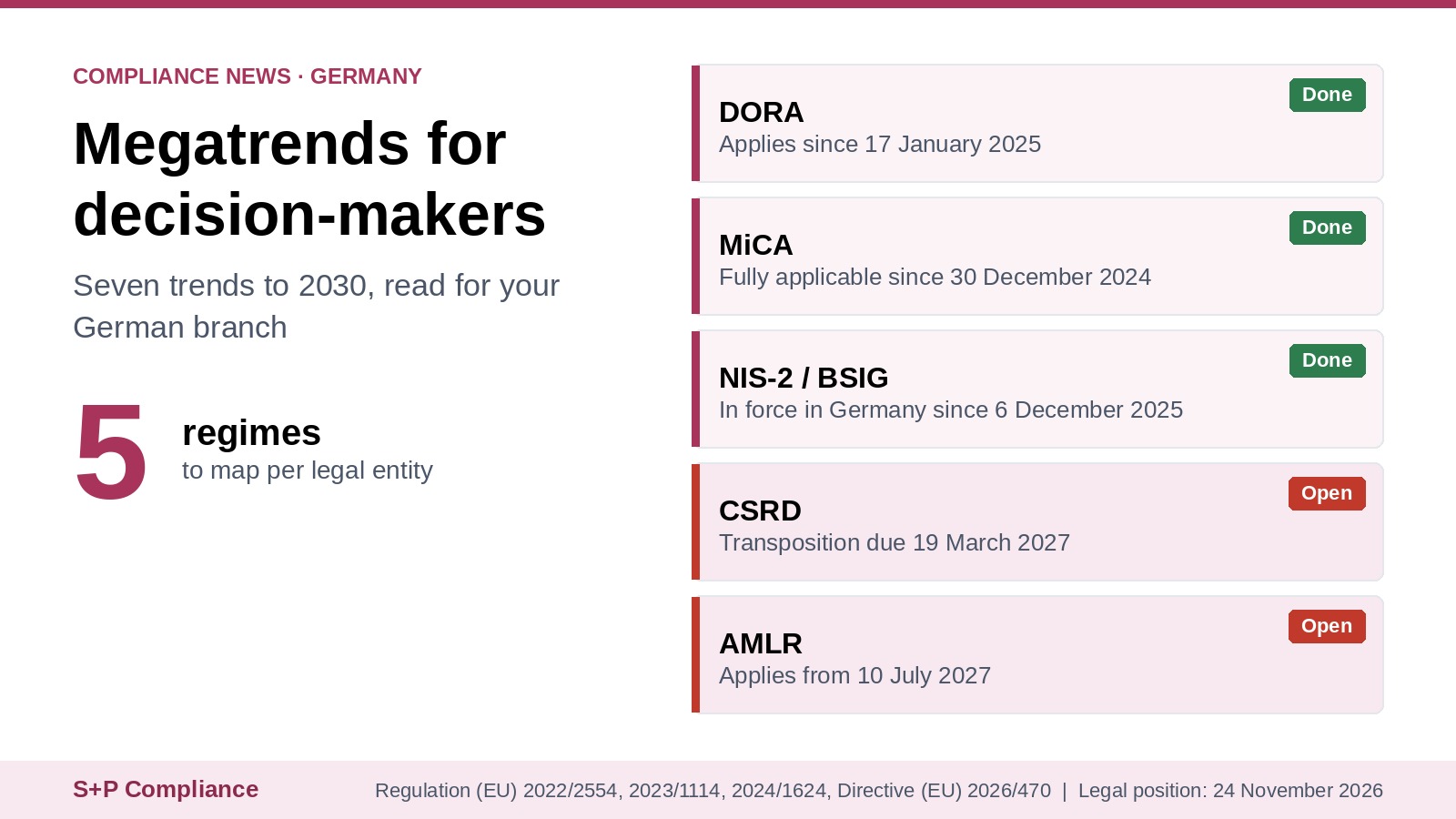
What changes. Five regimes now sit on top of each other: DORA, MiCA, Germany’s NIS-2 law, the amended CSRD and the AMLR. They differ in addressee, status and authority.
For your German branch. Treat the regimes as a map per legal entity, not as a list. The next sections give the status, the dates and the fork between DORA and the BSIG.
5Specialist and responsible staff
What changes. Hybrid teams and new expectations change what leadership means, while the number of regulated duties grows.
For your German branch. Name the responsible person in Germany for each regime and make sure that person can decide locally. An outsourced officer function adds capacity; it does not replace management attention.
6Technological sovereignty
What changes. Platforms, cloud providers and digital suppliers become critical infrastructure and a strategic dependency.
For your German branch. Map the ICT third-party arrangements that support German operations. DORA addresses third-party risk and gives supervisors a role over critical ICT providers; this is where sovereignty becomes a supervisory topic.
7Corporate governance in transition
What changes. Governance moves from box-ticking towards effectiveness: culture, transparency and impact.
For your German branch. German companies have a management body (the Vorstand of a stock corporation or the Geschäftsführung of a limited-liability company) and, in some legal forms, a supervisory board (Aufsichtsrat). Make clear which body approves what, and keep the evidence.