What the German and EU rules say
Who is bound. § 2 (1) GwG lists the obliged entities. They include capital management companies (Kapitalverwaltungsgesellschaften, no. 9), the German branches of EU management companies and certain foreign managers of alternative investment funds that BaFin supervises (also no. 9) and, when they help to plan or carry out the purchase or sale of businesses or advise on mergers and acquisitions, lawyers and notaries (no. 10). Whether your firm is one of them depends on its licence and its activities.
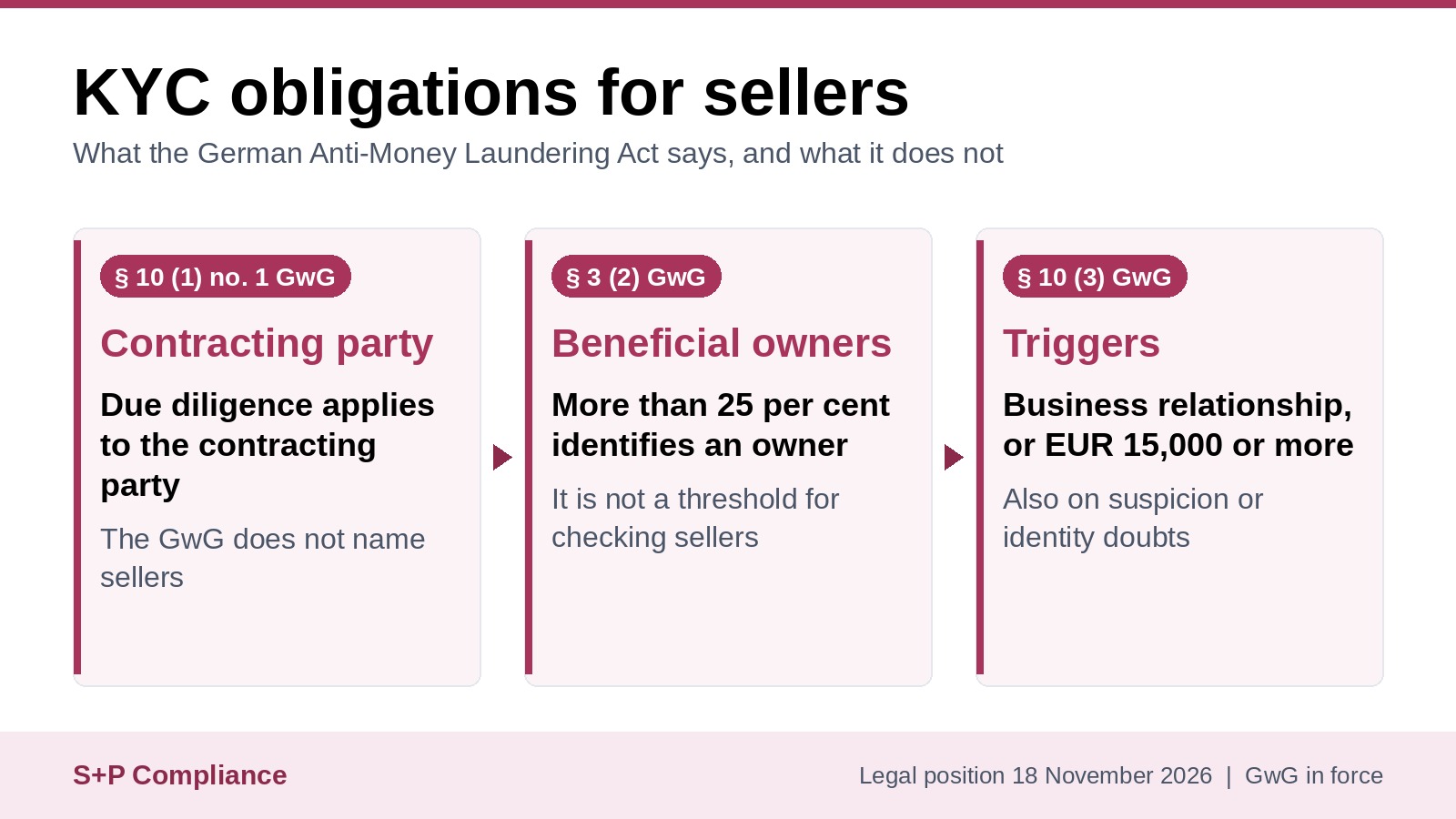
The contracting party. The general due diligence duties in § 10 (1) GwG refer to the contracting party (Vertragspartner) of the obliged entity. The firm must identify it and any person acting for it (no. 1), clarify whether it acts for a beneficial owner and identify that owner (no. 2), obtain information on the purpose and nature of the relationship where this is not already clear (no. 3), establish whether the contracting party or the beneficial owner is a PEP, a family member or a known close associate (no. 4) and monitor the relationship continuously (no. 5).
If the contracting party is not a natural person, the firm must find out its ownership and control structure with appropriate means.
The GwG does not mention sellers. On our reading, whether a seller is the contracting party of an obliged entity depends on the deal structure and on whose business activities the transaction belongs to. We have not reviewed supervisory guidance on sellers, so confirm the position with your legal adviser.
When the checks apply. § 10 (3) GwG names the occasions: the establishment of a business relationship (no. 1), a transaction outside a business relationship worth EUR 15,000 or more (no. 2 (b)), facts that point to money laundering or terrorist financing (no. 3) and doubts about the identity data collected (no. 4).
Under § 1 GwG, a business relationship is a relationship that is directly tied to the business activities of the obliged entity and is expected to last for some time. On our reading, a one-off purchase from a seller is more likely a transaction than a business relationship, so the EUR 15,000 occasion and the suspicion occasion are the ones to watch. This is not confirmed by supervisory guidance that we have reviewed.
The 25 per cent. The figure comes from § 3 (2) GwG. For a company that is not listed on an organised market and is not subject to equivalent transparency requirements, it counts as a beneficial owner any natural person who directly or indirectly holds more than 25 per cent of the capital shares, controls more than 25 per cent of the voting rights or exercises control in a comparable way. This is a test for the owner behind a company. It is not a threshold above which a seller must be checked.
Risk-based extent and enhanced due diligence. The extent of the measures in § 10 (1) nos. 2 to 5 GwG follows the risk (§ 10 (2) GwG). Where the risk is low, simplified due diligence under § 14 GwG can apply.
A higher risk exists in particular where the contracting party or a beneficial owner is a PEP, a family member or a known close associate (§ 15 (3) no. 1 GwG). In that case the establishment or continuation of the relationship needs the approval of a member of senior management, the origin of the assets must be established with appropriate measures and the relationship is monitored more closely (§ 15 (4) nos. 1 to 3 GwG).
If the checks cannot be completed. If the obliged entity cannot fulfil the general due diligence duties in § 10 (1) nos. 1 to 4 GwG, the business relationship may not be established or continued and no transaction may be carried out (§ 10 (9) GwG). On our reading, this is the point where a failed seller check can stop a deal that falls within the scope of the GwG.
Delegating the checks. § 17 (1) GwG lets an obliged entity use third parties for the duties in § 10 (1) nos. 1 to 4 GwG under conditions, and § 17 (5) GwG allows other suitable persons and companies to carry out the measures under a contract. Their measures count as the obliged entity’s own. The responsibility for the general due diligence duties stays with the obliged entity (§ 17 (1) GwG), and the transfer must not impair the firm’s ability to steer and control or the supervisory authority’s oversight (§ 17 (6) GwG).
The AMLR from 10 July 2027. The AMLR applies from 10 July 2027 and moves customer due diligence into directly applicable EU rules, in its Chapter III. On our reading, the logic of the GwG carries over, but we have not compared the texts article by article, and the details will depend on the AMLA’s technical standards.