01
The term
Know Your X
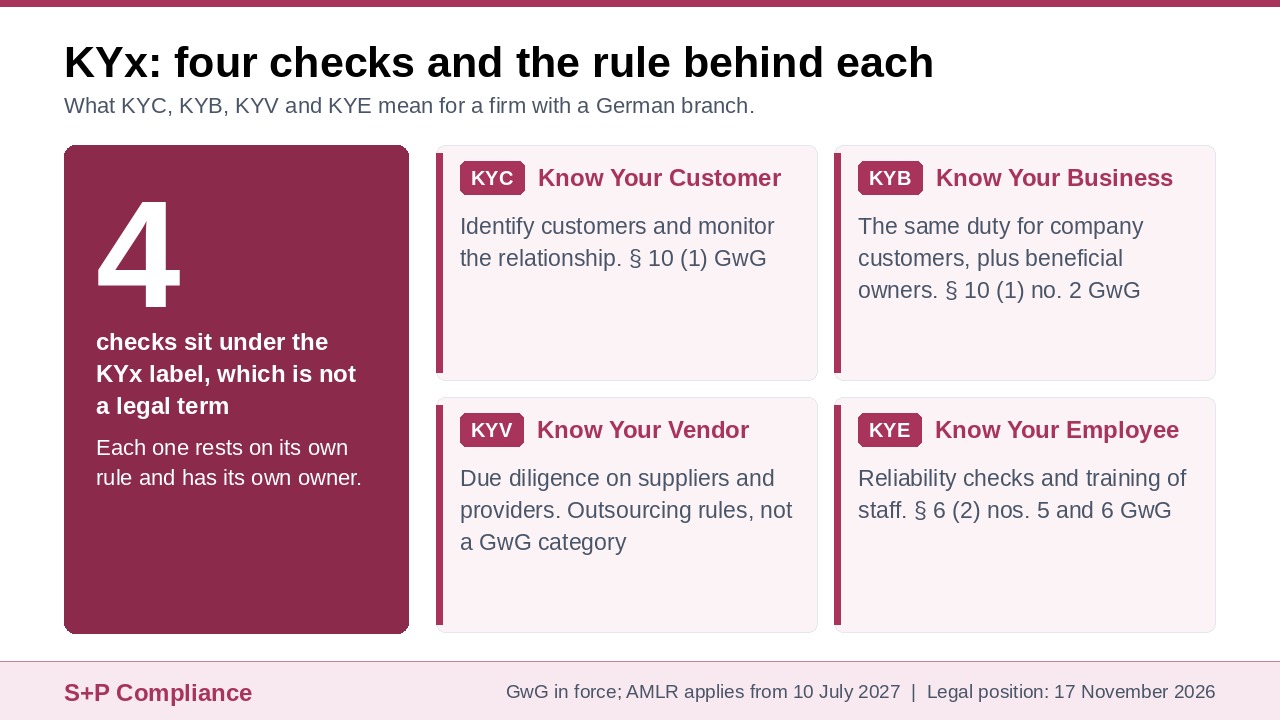
KYx is industry shorthand and not a legal term. It groups the checks on customers (KYC), business customers (KYB), vendors (KYV) and employees (KYE). The list is open, and other variants exist.
KYx stands for Know Your X, a family of due diligence checks: Know Your Customer (KYC), Know Your Business (KYB), Know Your Vendor (KYV) and Know Your Employee (KYE). For a firm with a German branch, which of them is a legal duty depends on who is being checked, and the main rules come from the German Anti-Money Laundering Act (Geldwäschegesetz, GwG).
KYx is a family of checks, not one rule. The GwG sets the duty for customers and beneficial owners (§ 10 (1) nos. 1 and 2 GwG) and for staff (§ 6 (2) no. 5 GwG); vendor checks follow your outsourcing rules. You can hand over the work, but control, decision authority and final responsibility stay with your firm.
01
The term
KYx is industry shorthand and not a legal term. It groups the checks on customers (KYC), business customers (KYB), vendors (KYV) and employees (KYE). The list is open, and other variants exist.
02
The duty
The GwG requires the identification of customers and beneficial owners (§ 10 (1) nos. 1 and 2) and continuous monitoring (no. 5). It also lists the reliability check of staff as an internal safeguard (§ 6 (2) no. 5).
03
The change
The Anti-Money Laundering Regulation (Regulation (EU) 2024/1624, AMLR) puts customer due diligence into directly applicable EU rules, in its Chapter III. It applies from 10 July 2027.
04
The split
A provider can collect documents, research ownership and prepare screening files. Your firm keeps the decision to refuse or end a relationship when checks cannot be completed (§ 10 (9) GwG) and the suspicious activity report to the FIU (the Financial Intelligence Unit) under § 43 GwG.
Different bodies set the rules, supervise them and receive reports. This overview helps if your head office is outside Germany and the German structures are new to you.
BaFin (the German Federal Financial Supervisory Authority, Bundesanstalt für Finanzdienstleistungsaufsicht) supervises banks, financial services institutions and other financial firms under the GwG. If you outsource your internal safeguards, you must notify the supervisory authority beforehand (§ 6 (7) GwG).
The FIU (Financial Intelligence Unit, Zentralstelle für Finanztransaktionsuntersuchungen) receives suspicious activity reports under § 43 GwG. Reports are filed electronically.
The Transparency Register (Transparenzregister) is the German register of beneficial owners. §§ 18 to 20 GwG set it up and regulate the transparency duties of certain entities.
The European Parliament and the Council adopted the AMLR. The AMLA (the EU Anti-Money Laundering Authority) was established by Regulation (EU) 2024/1620, and its guidelines and technical standards will add detail to the AMLR.
A firm that is an obliged entity under § 2 (1) GwG must run the checks. Whether your German branch is one is a question for your compliance and legal team.
As far as we could verify on 17 November 2026, KYx is not defined in the GwG or in the AMLR. The table maps each common KYx check to the rule behind it. The highlighted row shows where the legal basis is least obvious.
| Check | What it covers | Legal basis |
|---|---|---|
| KYC | Identify the customer and any person acting for it, clarify whether the customer acts for a beneficial owner, obtain information on the purpose and nature of the relationship, establish whether the customer or beneficial owner is a politically exposed person (PEP) and monitor the relationship. The extent follows the risk. | § 10 (1) nos. 1 to 5 GwG |
| KYB Key row | Same duty, company customer On our reading, the GwG has no separate regime for business customers. The same general due diligence duties apply, and for a company the firm must also find out who the beneficial owners are and identify them. The work is larger, because ownership structures need documents and registers. | § 10 (1) no. 2 GwG |
| KYV | Due diligence on suppliers and service providers. On our reading, it is not a GwG category. For outsourced functions of a German bank, the Minimum Requirements for Risk Management (MaRisk) apply, module AT 9, which expects the institution to stay able to steer and monitor the provider. | MaRisk AT 9 (German) |
| KYE | Check the reliability of staff through suitable measures, such as staff control and appraisal systems, and train staff on typologies and current methods of money laundering and terrorist financing. Staff checks involve personal data, so data protection and employment law apply as well. | § 6 (2) nos. 5 and 6 GwG |
Key point
KYB is not a separate legal regime.
On our reading, a company is a customer like any other under the GwG. What changes is the evidence: ownership structures, registers and documents. Which letters you use matters less than which duty each check serves.
Industry sources use further variants, such as checks on suppliers or on third parties in general. Use the term your auditors and your supervisor use, and record the legal basis next to it.
Chips in red mark the steps that are still ahead.
Done. The current GwG takes effect. It has been amended several times since.
Done. The AMLR is published in the Official Journal of the European Union.
Open. The AMLR applies. Customer due diligence then follows Chapter III of the Regulation.
Open. The AMLA is to publish technical standards and guidelines that add detail. We have not reviewed final texts, so check the AMLA’s own publications before relying on details.
Customer due diligence. § 10 (1) GwG lists the general due diligence duties: identify the contracting party and any person acting for it (no. 1), clarify whether it acts for a beneficial owner and identify that owner (no. 2), obtain information on the purpose and nature of the relationship (no. 3), establish whether the contracting party or the beneficial owner is a politically exposed person (no. 4) and monitor the relationship continuously (no. 5). The extent of the measures in nos. 2 to 5 follows the risk (§ 10 (2) GwG).
Simplified and enhanced due diligence. Depending on the risk, a firm applies simplified due diligence under § 14 GwG or enhanced due diligence under § 15 GwG. Enhanced due diligence includes the approval of a member of senior management to establish or continue a relationship, in higher-risk cases including PEP cases (§ 15 (4) no. 1 GwG) and in cases involving high-risk third countries (§ 15 (5) no. 2 GwG).
If the checks cannot be completed. If a firm cannot fulfil the general due diligence duties, § 10 (9) GwG applies: BaFin summarises the consequence as refraining from the relevant transaction or ending the business relationship.
Delegating customer checks. § 17 (1) to (4) GwG lets a firm use certain third parties for the duties in § 10 (1) nos. 1 to 4, also without a separate contract. § 17 (5) to (9) GwG allows other suitable persons and companies to perform them under a contract, including firms abroad, though not in high-risk third countries, and they must still apply German law. The responsibility stays with the obliged entity. BaFin notes that these forms of delegation need no prior notification.
Outsourcing internal safeguards. § 6 (7) GwG allows a firm to have a third party carry out its internal safeguards under a contract if it notifies the supervisory authority beforehand. The authority can prohibit the transfer if the third party does not offer assurance of proper performance, if the firm’s ability to steer is impaired or if supervision is impaired. The firm must show in its notification that none of these grounds applies, and the responsibility for the safeguards stays with the firm.
Staff. § 6 (2) no. 5 GwG lists the reliability check of staff, in particular through staff control and appraisal systems, as an internal safeguard. No. 6 adds initial and continuing training on typologies and current methods of money laundering and terrorist financing, including data protection rules. § 6 (5) GwG requires arrangements that let staff report breaches confidentially.
Vendors. As far as we could verify on 17 November 2026, the GwG has no vendor category. Whether vendor due diligence is required depends on the function: for a German bank, outsourcing is governed by the MaRisk, module AT 9, and the bank must stay able to steer and monitor the provider.
The AMLR from 10 July 2027. Customer due diligence then follows Chapter III of the AMLR. Article 20 sets out the measures, Article 21 the consequences if they cannot be applied, Article 22 the identification and verification of customers and beneficial owners and Article 24 the reporting of discrepancies with beneficial ownership registers. Article 18 deals with outsourcing. On our reading, the structure follows the logic of the GwG, but we have not compared the texts article by article, and the details will depend on the AMLA’s technical standards.
Scope. The GwG obliges economic agents operating in Germany. Whether a branch or subsidiary of a foreign group is an obliged entity depends on its business (§ 2 (1) GwG). A parent company of a group must also create group-wide procedures (§ 6 (2) no. 3 and § 9 GwG). Check both points with your German compliance and legal advisers.
Different people carry different parts of the work. The split below follows the functions that usually exist in a German bank or financial services institution.
A member of the management level is responsible for risk management and approves the risk analysis and the internal safeguards (§ 4 (3) GwG).
The Geldwäschebeauftragter and a deputy are appointed under § 7 GwG, as part of the internal safeguards (§ 6 (2) no. 2 GwG).
Collect and verify identification documents, research beneficial owners and keep the evidence on file.
Run the reliability checks and the training for staff (§ 6 (2) nos. 5 and 6 GwG), within the limits of data protection law.
Carry out vendor due diligence and keep control of outsourced functions, for banks under MaRisk AT 9.
You hand over the task, not the control. Control, decision authority and final responsibility stay with your firm. The GwG says the same for delegated customer due diligence (§ 17 GwG) and for outsourced safeguards (§ 6 (7) GwG).
These six points recur where firms organise their KYx checks. They do not replace a review of your own processes.
KYC, KYB, KYV and KYE rest on different legal bases and have different owners. One policy for all four hides the gaps.
§ 10 and § 6 GwG
For a company, the GwG requires you to find out who the beneficial owners are and to identify them.
§ 10 (1) no. 2 GwG
Delegation does not move it. The responsibility stays with the obliged entity.
§ 17 and § 6 (7) GwG
Outsourcing the internal safeguards needs prior notification of the supervisory authority.
§ 6 (7) GwG
Reliability checks are an internal safeguard, and training is initial and continuing.
§ 6 (2) nos. 5 and 6 GwG
The AMLR applies from 10 July 2027, and your checks need to be mapped to its articles beforehand.
Articles 19 to 25 AMLR
Check where your firm stands on its KYx checks. Select a status for each of the six questions. Nothing is stored or sent. The check is a self-assessment and does not replace legal advice.
These six steps help whatever your set-up, and they build the evidence that your supervisor, your auditors and your management ask for.
01
Write down every check on customers, business customers, vendors and employees, with the owner of each.
02
Note the legal basis next to each check, for example § 10 GwG, § 6 GwG or MaRisk AT 9.
03
Keep the evidence of who the beneficial owners are and how you found out.
04
Decide who refuses or ends a relationship, who approves enhanced due diligence and who signs off reports.
05
Record which tasks are delegated, where notification is needed and what stays with you.
06
Map your checks to Articles 19 to 25 of the AMLR and watch the AMLA’s publications.
Three key messages remain.
KYC, KYB, KYV and KYE are different checks with different legal bases and different owners.
Customer and beneficial owner checks and staff checks are statutory. Vendor checks follow your outsourcing rules.
A provider can take over tasks, but control, decision authority and final responsibility stay with your firm.
KYx comes down to three records: which legal duty each check serves, who decides on each outcome and what a provider may do for you. If you can show all three, you are ready for the GwG today and for the AMLR from 10 July 2027.
Where this sits in the S+P service model
Outsourced officer functions, including Internal Audit and Central Outsourcing Management, bundled in the S+P Compliance Package.
Operational work, such as financial crime and customer operations, carried out under your instructions.
Tools such as KYC as a Service and the S+P Compliance Cockpit that support both.
Officer functions and operational services are delivered separately, in organisation and in staffing.
The answers reflect the position on 17 November 2026 and do not replace legal advice in an individual case.
KYx stands for Know Your X. It is industry shorthand for a family of due diligence checks, mainly KYC (Know Your Customer), KYB (Know Your Business), KYV (Know Your Vendor) and KYE (Know Your Employee). As far as we could verify on 17 November 2026, neither the GwG nor the AMLR defines the term, so the legal duty comes from the rule behind each check.
KYC covers customers in general, and KYB is the term for checks on business customers. On our reading, the GwG has no separate KYB regime: the general due diligence duties of § 10 GwG apply, and for a company the firm must find out who the beneficial owners are and identify them (§ 10 (1) no. 2 GwG).
KYV stands for Know Your Vendor: due diligence on suppliers and service providers. Some web pages read KYV differently, for example as Know Your Visibility, but compliance glossaries use the vendor meaning. As far as we could verify on 17 November 2026, the GwG has no vendor category. For outsourced functions of a German bank, the MaRisk (module AT 9) apply, and the bank must stay able to steer and monitor the provider.
For firms that are obliged entities, partly. § 6 (2) no. 5 GwG lists the reliability check of staff as an internal safeguard, and no. 6 requires initial and continuing training. How far a check on an individual may go depends on data protection and employment law, which this article does not cover.
Parts of them, yes. The GwG allows the delegation of customer due diligence (§ 17 GwG) and the outsourcing of internal safeguards with prior notice to the supervisory authority (§ 6 (7) GwG). S+P Compliance prepares and runs the operational work, such as document checks, ownership research and screening files. Stays with you: the decision to refuse or end a relationship, the suspicious activity report to the FIU (§ 43 GwG), the sanctions block, the discrepancy report to the Transparency Register, the approval of scenarios and thresholds and the approval by senior management. You hand over the task, not the control.
From 10 July 2027, the AMLR applies directly, and customer due diligence follows Chapter III. On our reading, the structure is close to the GwG, but the details depend on technical standards that we have not reviewed. Plan now how your KYx checks map to Articles 19 to 25 of the AMLR.
Only official bodies are linked. The GwG is binding in German, and the English texts are for reading only.
Regulation (EU) 2024/1624 (AMLR). The Anti-Money Laundering Regulation: Chapter III on customer due diligence, Article 18 on outsourcing and the date of application. Official Journal text in English. eur-lex.europa.eu
BaFin: guidance on the GwG in English. BaFin’s English explanation of the three pillars of the GwG, including customer due diligence (§ 10, § 17) and the outsourcing of safeguards (§ 6 (7)). Published 27 January 2021, so later amendments are not reflected. bafin.de
BaFin: English translation of the GwG. An English translation of the Money Laundering Act published by BaFin, for reading only. The German text is the binding one. bafin.de
GwG, full text (German). The Act in the binding German version, including § 4, §§ 17 to 20 and § 43. German. gesetze-im-internet.de
§ 6 GwG, internal safeguards (German). Staff reliability and training in § 6 (2) nos. 5 and 6, the reporting channel for staff in § 6 (5) and the outsourcing of safeguards in § 6 (7). German. gesetze-im-internet.de
§ 15 GwG, enhanced due diligence (German). Enhanced due diligence, including the approval of a member of senior management in § 15 (4) no. 1 and § 15 (5) no. 2. German. gesetze-im-internet.de
Legal position on 17 November 2026. The AMLR applies from 10 July 2027, and the AMLA’s technical standards can change the details. Check the current texts before you rely on them.
KYx touches several workstreams. These pages connect.
Our RegTech offer for customer due diligence. The decision to accept or refuse a customer stays with your firm.
KYC and due diligence services for firms in Germany. Decisions and final responsibility stay with your firm.
Compliance monitoring as part of our RegTech offer. The approval of scenarios and thresholds stays with your firm.
A whistleblowing system. Staff need a confidential way to report breaches (§ 6 (5) GwG), and the handling of each case stays with your firm.
The Money Laundering Reporting Officer function for firms in Germany. Control, decision authority and final responsibility stay with your firm.
Support for the outsourcing management of firms in Germany, relevant to vendor due diligence and MaRisk AT 9.
Our article on KYC obligations for sellers in private equity transactions.
Online compliance courses by S+P Courses with a certificate. The programme covers compliance foundations and anti-money laundering.
We use cookies and similar technologies to improve your experience on our website. Read our Privacy Policy.