
EBA update on retail granularity: How to embed the one-step approach in your SFO in a legally robust way
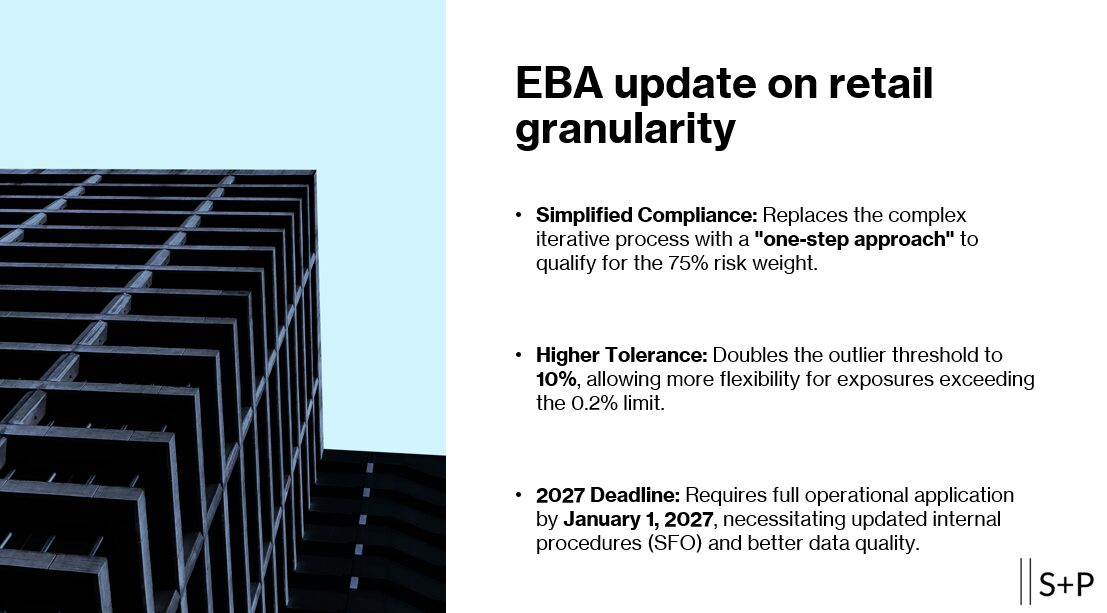
At its core, this is about the question of when a loan portfolio under the Standardised Approach is considered “sufficiently granular” in order to benefit from the privileged risk weight of 75% (instead of 100%). While the draft phase was still characterised by a bureaucratic “iterative procedure” that would have posed operational hurdles for many institutions, the EBA has now established the one-step approach .
This simplification, coupled with raising the tolerance threshold to 10%, is a win for proportionality. Institutions thus gain planning certainty for their RWA calculation (Risk Weighted Assets).
The guidelines harmonise the application of Art. 123 CRR across the EU and close the gap to the Basel III framework. For banks, this means: the hurdles for capital relief in the retail business are lowered, while the requirements for data quality and the identification of connected clients (Art. 4 CRR) remain measurable. An important step to strengthen the competitiveness of European retail banking.
The timing of the EBA could hardly be more relevant: with the final guidelines on proportional diversification of retail exposures published on 13 February 2026, the supervisor finally provides the urgently needed clarity for the application of Art. 123 CRR. While the consultation draft still threatened with a complicated iterative procedure, the EBA has now shown an understanding of institutions’ operational reality. By switching to a one-step approach and raising the tolerance limit to 10% the administrative effort is significantly reduced without jeopardising regulatory certainty.
For banks, this means a more stable basis for making use of the privileged risk weight of 75%. The guidelines harmonise the assessment of granularity across the EU and thus consistently implement the Basel III framework. This is not just about technical details, but about optimising capital requirements under the Standardised Approach—a lever that is crucial for the profitability of the retail business in the current market environment.
FAQ: EBA guidelines on the granularity of retail portfolios – What does the SFO update mean?
What do the new EBA guidelines of 13 February 2026 regulate?
The EBA guidelines specify the application of Art. 123 CRR
on the diversification of retail exposures under the Standardised Approach.
The aim is an EU-wide harmonised assessment of when a
loan portfolio is sufficiently granular in order to be able to apply the
privileged risk weight of 75% instead of 100%.
Why are the guidelines economically relevant for banks?
The 75% risk weight reduces Risk Weighted Assets (RWA)
compared with the standard risk weight of 100%. This lowers
the capital requirement and institutions can deploy capital more efficiently—
for example for new business or to improve
return on equity (RoE).
What does the 0.2% granularity criterion mean?
Under Art. 123(1)(c) CRR, the total exposure
to a single client or a group of connected clients
may be a maximum of 0.2% of the total retail portfolio.
This criterion ensures that no excessive
concentration of individual borrowers arises.
What changes with the new 10% tolerance threshold?
Individual exposures may exceed the 0.2% limit,
provided that these exceedances in total account for no more than
10% of the total retail portfolio.
This significantly softens the previously planned stricter interpretation
and makes it more practical.
What does the EBA’s new one-step approach mean?
The EBA dispenses with the originally planned
iterative review procedure. Instead of several calculation steps,
granularity is now checked in a single
calculation step. This reduces
complexity, susceptibility to errors and audit effort.
What role does the “group of connected clients” (GCC) play?
The granularity test is carried out not only at the
individual borrower level, but at the level
of a group of connected clients pursuant to
Art. 4(1)(39) CRR.
Incorrectly identified client connections can
lead to the 0.2% limit being exceeded
unnoticed.
How important is data quality for applying the 75% risk weight?
A precise data basis is crucial.
Without complete information on
borrower structures, beneficial owners
and client connections, granularity
cannot be demonstrated. In this case,
the privileged risk weight may be
withdrawn by the supervisor.
What interface is there with anti-money laundering (AML) prevention?
AML and KYC data are central for the
identification of groups of connected clients.
The information on beneficial owners
and corporate links forms the
basis for the correct aggregation of
credit risks within the meaning of the CRR.
What tasks arise for compliance departments?
Compliance must continuously monitor compliance with the 10% ratio
and ensure that the one-step approach is correctly documented in the
Written Procedures (SFO).
In addition, review processes to validate
data aggregation are required.
What deadlines apply for implementing the guidelines?
The final guidelines were published on 13 February 2026.
After completion of the translation phase and adoption
into national supervisory practice, full
operational application is expected from
1 January 2027—consistent with
the Basel III/CRR III framework.
What adjustments are necessary in the Written Procedures (SFO)?
Institutions must update internal policies,
in particular on the calculation of granularity,
on the definition of connected clients,
on monitoring the 10% ratio and on
documenting the one-step procedure.
These adjustments should be implemented well in advance
of the entry into force in 2027.
I. EBA granularity criteria
EBA granularity criteria – retail portfolio
Requirements for 75% risk weight under Art. 123 CRR
0,2% Basic criterion (Art. 123(1)(c) CRR)
No single exposure may exceed 0.2% of the total retail portfolio.
Gold standard of granularity and diversification.
10% Tolerance threshold for outliers
The 75% risk weight remains permissible if outliers in total account for a maximum of 10%
of the portfolio value. Doubling compared to the original draft.
1× One-step calculation instead of iteration
No multi-stage calculation procedure—RWA calculation becomes less prone to errors
and easier for internal audit to review.
§ Differentiation for securitisations
Specific review mechanisms for originators and investors.
Clear inclusion of securitised retail receivables in the granularity test.
Data safe harbour for investors
Temporary exemption where obligor data are missing due to a lack of
transparency templates—pragmatic bridge for the secondary market.
Group of connected clients (Art. 4(1)(39) CRR)
Precise identification of client connections required—
faulty aggregation can violate the 0.2% criterion unnoticed.
Coordination across Risk, Compliance and IT required—
internal positions ideally aligned by the end of April.
- The 0.2% basic criterion (Art. 123(1)(c) CRR): To ensure granularity, the total risk vis-à-vis a single client (or a group of connected clients) may not exceed 0.2% of the total retail portfolio. This remains the “gold standard” of diversification.
- The 10% tolerance threshold: Institutions may apply the 75% risk weight even if individual positions breach the 0.2% hurdle—provided that these “outliers” in total account for no more than 10% of the portfolio value. This is a doubling compared to the original draft.
- One step instead of iteration: The EBA dispenses with the originally planned multi-stage calculation procedure. This makes the calculation of RWAs (Risk Weighted Assets) less prone to errors and easier for internal audit to review.
- Differentiation for securitisations: The guidelines introduce specific review mechanisms for originators and investors. This clarifies how securitised retail receivables are to be included in the granularity test.
- Data safe harbour for investors: For investors in securitisations, there is a temporary exemption if obligor data are not immediately available due to missing transparency templates—a pragmatic bridge for the secondary market.
- Harmonisation of the “group of connected clients” (Art. 4(1)(39) CRR): The guidelines sharpen the need to identify client connections precisely, as faulty aggregation can violate the 0.2% criterion unnoticed.
- II. Strategic relevance: Compliance, AML & C-level
- Compliance & data quality: Monitoring the 10% ratio requires robust reporting. Compliance departments must ensure that thresholds are not gradually exceeded, as this would have immediate effects on capital requirements.
- Anti-money laundering (AML) & KYC: Identifying “groups of connected clients” is a prime example of synergies. The data AML teams collect to identify beneficial owners are the foundation for correct risk weighting. No clean KYC, no 75% privilege.
- C-level (capital efficiency): For CFOs and CROs, the rule is a lever for return on equity (RoE). The difference of 25 percentage points in risk weight can free up millions in CET1 for large portfolios, which can be used for new business or dividends.
II. Timeline: The key deadlines at a glance
Key deadlines at a glance
EBA guidelines · implementation roadmap 2026–2027
2026
13 February 2026
Official publication of the final guidelines
Starting signal for the internal gap analysis. Institutions must compare existing
processes and systems with the new granularity requirements.
2026
Q2 / Q3 2026
Translation & adoption into national supervisory practice
Completion of the translation phase into all EU official languages and
subsequent adoption into the national supervisory practice of the Member States.
2027
1 January 2027
Full operational application
Expected date for full implementation in line
with the final Basel 3.1 / CRR III package. Systems, reporting and
processes must be fully adapted.
internal positions ideally aligned by the end of April 2026.
- 13 February 2026: Official publication of the final guidelines (starting signal for the gap analysis).
- Q2/Q3 2026: Completion of the translation phase into all EU official languages and subsequent adoption into national supervisory practice.
- 1 January 2027: Expected date for full operational application in line with the final Basel 3.1 / CRR III package.
III. Specific duties for persons acting with responsibility
Duties for the key functions
EBA granularity criteria · responsibilities & normative references
PLI
1. Compliance · monitoring & governance
Responsibility for the regulatory framework
- Monitoring dutyMonitoring of the 10% ratio to prevent
“threshold creep”—a gradual exceedance would lead to
sudden additional capital requirements. - Process auditEnsuring that the one-step approach is consistently
and audit-proof embedded in the documentation.
KYC
2. AML officer / AML · data synergies
AML data are now worth “hard capital”
- KYC data qualityIdentification of beneficial owners and interconnections as the foundation
for forming the “group of connected clients”.
AML data must flow precisely into risk management. - Identification dutyWithout seamless KYC, the 75% privilege may be
withdrawn during an audit, because granularity cannot
be demonstrated.
3. C-level · strategy & capital efficiency
CFO & CRO — a question of profitability
- Capital planningDifference between 75% and
100% risk weight as a lever for
return on equity (RoE). Management must define risk appetite
regarding the 10% tolerance. - Resource allocationEnsuring that IT and risk reporting can implement the new
data requirements in time by
1 January 2027.
internal positions ideally aligned by the end of April 2026.
1. Compliance (Monitoring & governance)
The compliance function is responsible for compliance with the regulatory framework.
Monitoring duty: monitoring of the 10% ratio to prevent “threshold creep” (gradual exceedance), which would lead to sudden additional capital requirements.
Process audit: ensuring that the one-step approach is consistently and audit-proof embedded in the documentation.
Normative reference: Art. 123 CRR in conjunction with MaRisk (AT 4.4.2).
2. AML officer / AML (data synergies)
Although primarily responsible for AML, these data are now worth “hard capital”.
KYC data quality: Identifying beneficial owners and interconnections is the foundation for forming the “group of connected clients”. AML data must flow precisely into risk management.
Identification duty: Without seamless KYC, the 75% privilege may be withdrawn during an audit, because granularity cannot be demonstrated.
Normative reference: Art. 4(1)(39) CRR & GwG.
3. C-level (strategy & capital efficiency)
For CFOs and CROs this is a question of profitability.
Capital planning: The difference between 75% and 100% risk weight is a lever for return on equity (RoE). Management must define risk appetite with regard to the 10% tolerance.
Resource allocation: Ensuring that IT and risk reporting can implement the new data requirements in time (by 1 January 2027).
Normative reference: Strategic responsibility pursuant to KWG / CRD.
IV. Key problem areas
Summary of problem areas
EBA granularity criteria · risks by stakeholder function
| Stakeholder | Core issue | Consequence in case of errors |
|---|---|---|
|
C-
LVL C-level
|
Capital tied up & strategy
|
↓Declining return on equity
|
|
COM
PLI Compliance
|
Data precision
(GCC formation) |
↓Findings in supervisory inspections
|
|
AML
KYC Money laundering
|
Data reconciliation
(KYC vs. CRR) |
↓Missing money-laundering structures
|
internal positions ideally aligned by the end of April 2026.
The publication of the final EBA guidelines on 13 February 2026 marks a turning point for the regulatory treatment of retail portfolios. While raising the tolerance ratio to 10% and dispensing with the iterative procedure may sound like relief on the surface, the devil is in the detail for the various function holders.
Here is an analysis of the specific challenges for the roles involved:
1. C-level (CEO, CRO, CFO)
For executive management and the management board, capital costs and strategic direction are the focus.
- RWA volatility & capital planning: If a portfolio fails to meet the granularity criteria (0.2% threshold incl. 10% tolerance), the risk weight jumps from 75% to 100%. This has immediate effects on the Common Equity Tier 1 (CET1) ratio. Management must decide whether buffers should be held or whether riskier large retail loans should be reduced.
- IT investment backlog: The “one-step approach” sounds simple, but it requires precise, automated data aggregation. The C-level must approve budget for adapting core banking systems to ensure daily or monthly monitoring.
- Competitiveness: Institutions that can efficiently utilise the 10% ratio can price more aggressively than those that remain conservatively below 5% to keep buffers.
2. Compliance function
Compliance faces the task of guaranteeing adherence to rules in a complex data environment.
- Delineation of the “group of connected clients” (GCC): This is the biggest operational hurdle. The 0.2% threshold does not apply per individual contract, but per group of connected clients. Compliance must ensure that the linking logic (control and economic dependency) meets CRR requirements.
- Monitoring the 10% ratio: Monitoring the exceedance ratio is a “moving target”. Since the total volume of the portfolio is constantly changing, repayment of a large loan or new business can cause other loans to suddenly breach the 10% limit.
- Documentation duties: Particularly when relying on the “temporary exemption” for securitisations, compliance must be able to demonstrate seamlessly why data were not available and when they were requested.
3. Money Laundering Reporting Officer (MLRO)
Although these are primarily credit risk rules, there is a critical interface with anti-money laundering.
- Data inconsistency (KYC vs. risk): If the risk department aggregates clients into a “group of connected clients” (e.g. due to economic dependence), but the AML department does not see these connections in its KYC profiles, a compliance risk arises. The MLRO must check whether these credit linkages indicate concealed structures or strawman arrangements.
- Increased transparency for securitisations: The guidelines require investors to have greater access to obligor data. If, as part of this review, the MLRO becomes aware of problematic end borrowers in an acquired portfolio, the question arises of reporting obligations (SAR) and reputational risk.
IV. Catalogue of measures
Priority measures · EBA guidelines 2026
From reactive reporting to proactive steering — one-step approach & 10% tolerance limit
1. Strategic & steering measures
C-level · CFO & CRO
Adjust the Risk Appetite Framework (RAF)
Do not utilise the 10% ratio to the limit.
Define internal warning thresholds, e.g. at 8.5%,
so that market fluctuations do not immediately push you into the 100% RWA range.
RWA impact analysis & capital allocation
Simulate how exceeding the 10% limit affects the CET1 ratio.
Adjust pricing for large retail loans (close to the 0.2% threshold)
where appropriate.
Approve budget for data infrastructure
Ensure IT resources so that the granularity test can be carried out
automated and daily.
& IT
2. Operational & technical measures
Risk management & IT
Automate the one-step approach
Implement an algorithm:
- Sum the total portfolio.
- Identify all GCCs that account for > 0.2%.
- Check whether their sum is ≤ 10% of the total volume.
Data clean-up of GCCs
Error-free linking of borrowers at GCC level.
Outdated links create artificial granularity
— risk of massive additional capital requirements in an audit.
Dashboarding for real-time monitoring
Reporting tool to visualise the
current utilisation of the 10% ratio
to allow early countermeasures, e.g. via sales or synthetic hedges.
AML
3. Monitoring & review measures
Compliance & AML
Harmonise GCC logic (Risk & AML)
Data reconciliation: If Risk recognises an economic unit,
AML must check whether this is stored in the KYC profile.
Resolve inconsistencies.
Update compliance policies (SFO)
Incorporate the new thresholds and the
one-step procedure into internal
work instructions (Written Procedures).
Due diligence for securitisations
Document the process for missing obligor data —
secure evidence of data procurement to rely on the
temporary exemption
in a legally robust manner.
To comply with the new EBA guidelines (as of February 2026), institutions must move from purely reactive reporting to proactive steering. The changeover from the iterative procedure to the one-step approach with the 10% tolerance limit requires concrete procedural and technical adjustments.
Here are the priority measures, broken down by functional areas:
1. Strategic & steering measures (C-level)
Adjust the Risk Appetite Framework (RAF): The 10% ratio should not be utilised to the limit. Management must define internal warning thresholds (e.g. at 8.5%) so that market fluctuations do not immediately push the institution into the 100% RWA range.
RWA impact analysis & capital allocation: Run a simulation of how exceeding the 10% limit affects the CET1 ratio. Where appropriate, pricing for “large retail loans” (close to the 0.2% threshold) must be adjusted to reflect higher capital consumption.
Approve budget for data infrastructure: Ensure that IT resources are available to carry out the granularity test in an automated and timely manner (ideally daily).
2. Operational & technical measures (risk management & IT)
Automate the one-step approach: Implement an algorithm that:
Sums the eligible total portfolio.
Identifies all groups of connected clients (GCCs) that account for > 0.2%.
Checks whether their sum is ≤10% of the total volume.
Data clean-up of “groups of connected clients” (GCCs): Since the 0.2% threshold applies at GCC level, error-free linking of borrowers is essential. Outdated or missing links lead to artificial granularity, which can result in massive additional capital requirements in an audit.
Dashboarding for real-time monitoring: Build a reporting tool that visualises the current utilisation of the 10% ratio to allow early countermeasures (e.g. through sales or synthetic hedges).
3. Monitoring & review measures (compliance & AML)
Harmonise GCC logic between Risk and AML: Carry out a data reconciliation. If the risk department recognises an economic unit (for the 0.2% threshold), the AML department must check whether this information is also stored in the KYC profile. Inconsistencies must be resolved.
Update compliance policies: Incorporate the new thresholds and the one-step procedure into internal work instructions (Written Procedures – SFO).
Due diligence for securitisations: Create a process for cases where obligor data are missing. It must be documented what efforts were made to obtain the data in order to rely on the “temporary exemption” in a legally robust manner.
Official source of the European Banking Authority (EBA)
- EBA – Final Report on Guidelines on Retail Diversification (February 2026)
Guidelines of the European Banking Authority on diversification of retail exposures as part of supervisory requirements.
View the EBA Final Report
[PDF]