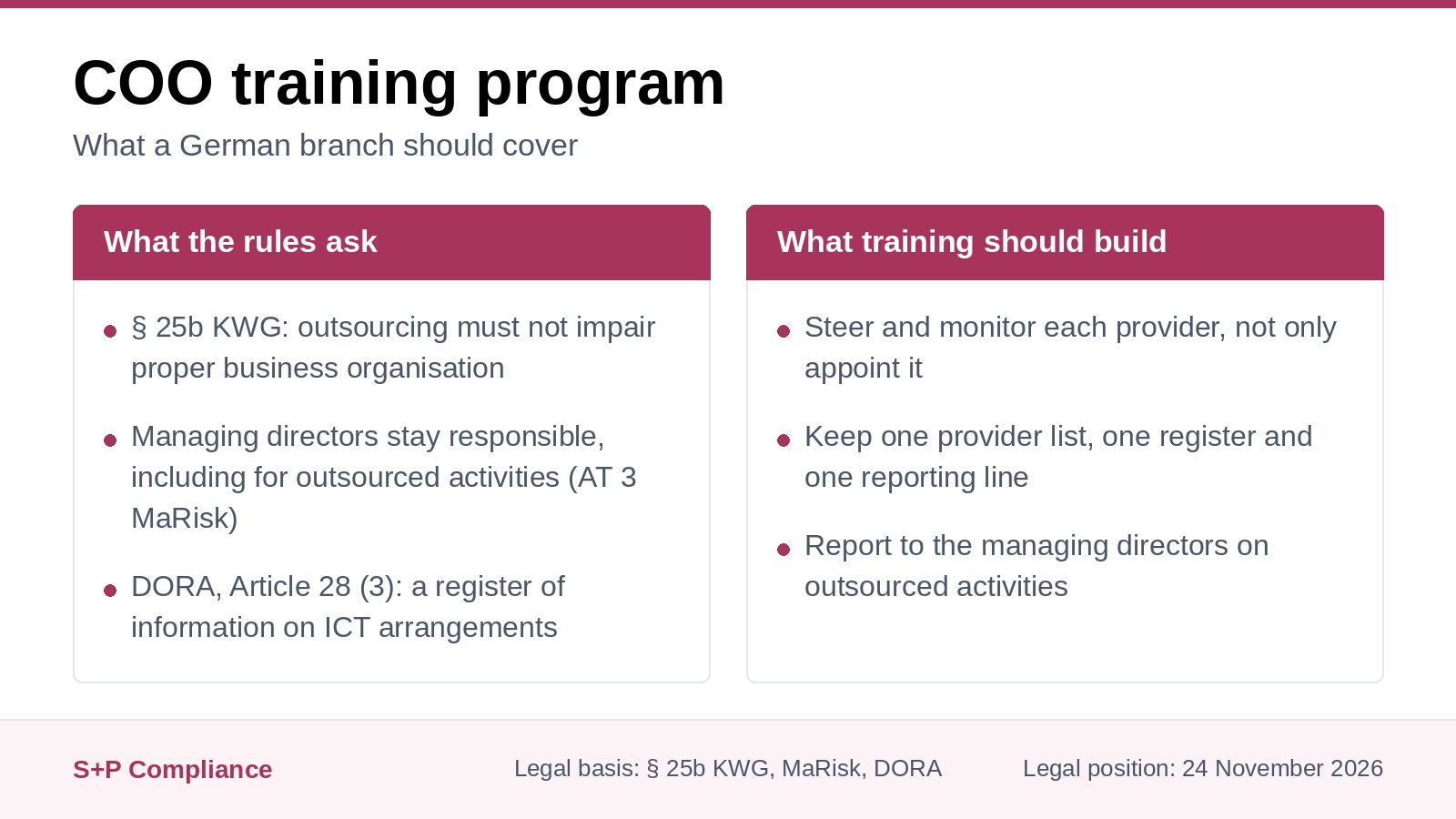
COO training program for German branches and subsidiaries
A COO training program is worth more to a German branch when it covers the supervisory side of operations, not only process and change skills. This article sets out what German outsourcing and resilience rules ask of the person who runs operations, and where the S+P course fits.
The essentials in four points
Operations under German supervision
A COO of a German branch or subsidiary runs operations in an environment where BaFin (the German Federal Financial Supervisory Authority) expects management to keep control of what is outsourced. BaFin publishes its reading of § 25a and § 25b KWG in the MaRisk (Minimum Requirements for Risk Management). Its module AT 9 (AT stands for Allgemeiner Teil, the general part) deals with outsourcing.
What § 25b KWG fixes
Outsourcing must not impair the proper business organisation of the institution. The institution must keep adequate and effective risk management that includes the outsourced activities. The precautions depend on the nature, scale, complexity and risk of the outsourcing. BaFin’s information, audit and control rights must remain in place (§ 25b (3) KWG).
Where digital resilience rules add a register
DORA (Digital Operational Resilience Act, Regulation (EU) 2022/2554) requires financial entities to manage ICT (information and communication technology) third-party risk as part of their ICT risk management (Article 28 (1)). They must also keep a register of information on all contractual arrangements for ICT services (Article 28 (3)). Whether your entity is in scope is a separate check.
What a COO training program should cover
The S+P course for COOs teaches operational excellence, leading transformation projects and strategic risk assessment. For a German branch we suggest adding the supervisory interface: how outsourcing is steered, monitored and documented. That addition is our recommendation, not a requirement of the rules.
Table of contents
- Who does what in Germany
- What a COO training program should add in Germany
- From the 2024 circular to the 2026 revision
- Responsibilities by function
- What stays with your firm
- Where operations teams run into trouble
- Quick check: where do you stand?
- Six no-regret measures
- Conclusion
- Frequently asked questions
- Sources
- Related services and programmes
Who does what in Germany
Readers from outside Germany often meet these names for the first time. This is the short map for a COO.
What a COO training program should add in Germany
Chief operating officer training usually starts from skills. For a German branch, it also helps to start from the norms that frame the job. The table lists the ones we consider most relevant for operations. It is not a complete list of German outsourcing rules.
| Norm | What it asks | Why it matters for a COO |
|---|---|---|
| § 25b (1) KWG | Outsourcing must not impair proper business organisation. The institution keeps adequate and effective risk management that covers the outsourced activities. | Providers must be steerable and monitorable. This is the row that shapes daily operations. |
| § 25b (3) KWG | BaFin’s information, audit and control rights must remain in place for outsourced activities and processes. | Contracts and processes must leave room for supervisory access. |
| AT 3 MaRisk | Managing directors are responsible for proper business organisation. The responsibility covers the material elements of risk management, taking outsourced activities into account. | Operations needs a reporting line to the managing directors. |
| AT 9 MaRisk | The module BaFin dedicates to the management of outsourcing arrangements. | Reference point for outsourcing governance. We did not verify every detail of the 2026 text. |
| Article 28 (3) DORA | A register of information on all contractual arrangements for ICT services, kept up to date. | One consistent list of providers is needed across operations and compliance. |
From the 2024 circular to the 2026 revision
The MaRisk were revised in 2026. Press and consultancy commentary describes the revised AT 9 as more principle-based. We have not verified every change in the final AT 9 text, so please read the circular itself for your own case.
Done. BaFin publishes MaRisk Circular 06/2024 (BA).
Done. BaFin puts the next MaRisk revision out for consultation (Consultation 02/2026).
Done. BaFin publishes the final Circular 06/2026 (BA), the ninth revision of the MaRisk.
Open. The DORA register of information has to be kept up to date (Article 28 (3) DORA).
Open. Check your own outsourcing documents against the 2026 text. This is our recommendation, not a statutory deadline.
Responsibilities by function
The split below is our reading of how the responsibilities fit together in practice. It is not prescribed in this form by the rules.
Managing directors
Carry the overall responsibility for proper business organisation (AT 3 MaRisk). They need reporting from operations that shows how outsourced activities perform.
COO or head of operations
Runs the steering of providers day to day: service reviews, escalation, the provider list and the register. On our reading, this is where a training programme should concentrate.
Control functions
Compliance, risk control and internal audit review the arrangements independently of operations. How their roles are split with the outsourcing function depends on your size and set-up, and we do not decide it here.
What stays with your firm
Control, decision authority and final responsibility stay with your firm. On our reading, § 25b KWG and AT 9 MaRisk mean that the institution has to remain able to steer and monitor what it outsources.
Stays with your firm
- Control, decision authority and final responsibility for every outsourced task
- The decision to file a suspicious activity report with the FIU (German Financial Intelligence Unit) under § 43 GwG (German Anti-Money Laundering Act, Geldwäschegesetz)
- Sanctions holds
- Discrepancy reports to the Transparency Register
- Release of scenarios and thresholds
- Senior management approval under § 15 (5) no. 2 GwG
- Steering of providers and reporting to the managing directors
A provider can prepare and run
- Preparing cases to your instructions
- Collecting and checking documents, data and evidence
- Running first-line processes under your rules
- Drafting reports for your decision
- Keeping registers and lists current at your direction
- Producing monitoring reports on provider performance
You hand over the task, not the control.
Where operations teams run into trouble
Providers chosen on price, steered later
Outsourcing is agreed quickly, while steering and monitoring are set up afterwards, or not at all. The institution has to keep risk management that covers the outsourced activities.
The register lags behind the contracts
ICT arrangements sit in procurement, IT and operations, and nobody owns one complete list. The register has to cover all contractual arrangements for ICT services.
Training covers soft skills only
Leadership and change courses help, but they rarely cover how outsourcing is documented and reported to the managing directors.
Group providers are overlooked
A branch often receives services from the group. The register templates also cover contractual arrangements with intra-group ICT service providers.
Supervisory access is not planned
Contracts are written for service levels, and BaFin’s information, audit and control rights are added late. They have to remain in place for outsourced activities.
Documents cite an old circular
Policies still refer to the 2024 text although BaFin published a final revision on 30 June 2026.
Quick check: where do you stand?
Answer the six questions below. Each answer shows a recommendation. Nothing is stored or sent.
1. Do you hold one current list of every outsourced activity, with a named owner?
Good. Keep the list as the single source for the register and for reporting.
Close the gaps by naming an owner for each line, starting with the activities that matter most to your business.
Start here. Without this list, steering, the register and reporting cannot be built.
2. Does your register of information match that list?
Good. Agree who updates both lists when a contract changes.
Reconcile the two lists and note which ICT arrangements are missing from the register (Article 28 (3) DORA).
Check first whether your entity is in scope of DORA. If it is, build the register from your provider list.
3. Can you show how each provider is monitored: reports, reviews and escalation?
Good. Check that the reports reach the people who decide.
Define for each arrangement which reports you receive, how often, and who acts on them.
Define a minimum monitoring routine for the most important providers first.
4. Do the managing directors receive regular reporting on outsourced activities?
Good. Make sure the reporting also names open issues, not only results.
Fix the frequency and content of the reporting, and name who prepares it (AT 3 MaRisk).
Agree a first short report with the managing directors and extend it from there.
5. Do your policies cite the current MaRisk text, Circular 06/2026 (BA)?
Good. Note the date of your last review in the document.
Update the references and check which procedures the revision touches.
Compare your outsourcing policy with the 2026 text before your next audit.
6. Has your operations team been trained on the supervisory interface, not only on process and change?
Good. Repeat the training when roles or providers change.
Add a module on outsourcing steering and reporting to the existing COO training.
Choose a training that covers both operational leadership and the supervisory side.
Six no-regret measures
These steps make sense whichever way the open questions above are settled. Seminar suggestions link to the English seminar site sp-courses.com. The seminars run in German with AI-supported translation.
List every outsourced activity
Name an owner for each one and record the provider, the scope and the review date.
Align the register with the list
Compare the DORA register of information with your provider list and close the gaps.
Define what steering means
Per arrangement: which reports, how often, who reviews, who escalates.
Agree the reporting line
Set the content and frequency of reporting from operations to the managing directors.
Check your documents against 2026
Replace references to the 2024 circular and review the outsourcing policy.
Choose training by gap
Match the gaps above to a course: operational excellence, transformation, risk assessment, or the managing directors’ compliance update.
Conclusion
Outsourcing does not move risk management out of your institution (§ 25b KWG).
A COO needs the supervisory interface, not only process and change skills.
Start with one provider list, one register and one reporting line.
A COO training program for a German branch should combine operational leadership with the supervisory basics set out above. The S+P course covers operational excellence, transformation projects and strategic risk assessment. Add the steering and reporting of outsourced activities, and the course becomes a practical part of your governance. You hand over the task, not the control.
How S+P Compliance supports German operations
Compliance as a Service
Outsourced control functions such as Money Laundering Reporting Officer, Compliance Officer, MaRisk Compliance Officer, Internal Audit and Central Outsourcing Management, bundled in the S+P Compliance Package.
1st Line Services
Operational processing under your instructions in four clusters: Financial Crime and Customer Operations, Regulatory Data and Governance Operations, DORA, Outsourcing and Third-Party Operations, and Securities, Credit and Reporting Operations.
RegTech
S+P Compliance Cockpit, KYC as a Service, S+P IntegrityMonitoring, S+P IntegrityWatch, TMaaS and the Information Register DORA and XBRL.
Control-function roles and 1st Line Services are delivered separately, in organisation and in staffing. Control, decision authority and final responsibility stay with your firm.
Frequently asked questions
Does a COO training program replace outsourcing governance?+−
No. Training builds skills, while governance is a set of decisions, lists and reports in your firm. A good programme helps your team run that governance, but it does not replace it.
What does § 25b KWG ask of the person who runs operations?+−
It asks that outsourcing does not impair proper business organisation and that the institution keeps adequate and effective risk management that covers the outsourced activities. In practice, the COO needs to be able to steer and monitor each provider.
Does DORA apply to my German branch?+−
That depends on the legal form and licence of your German entity, and we do not decide it here. Where DORA applies, Article 28 (3) requires a register of information on all contractual arrangements for ICT services.
Can a provider take over responsibility for outsourced operations?+−
No. A provider can prepare and run defined tasks under your instructions. Control, decision authority and final responsibility stay with your firm. You hand over the task, not the control.
Which MaRisk text is current?+−
BaFin published the final Circular 06/2026 (BA) on 30 June 2026. The texts are in German. As far as we could verify on 24 November 2026, we did not find an official English translation of the 2026 text.
Are the S+P seminars available in English?+−
The S+P seminars run in German with AI-supported translation, and English-speaking participants take part. Please check dates and format on sp-courses.com before you book.
Sources
Sources are limited to official bodies. Press and consultancy commentary on the 2026 MaRisk revision informed our reading but is not linked.
Related services and programmes