
Are you ready for the BaFin exam? How safely do you navigate governance and compliance?
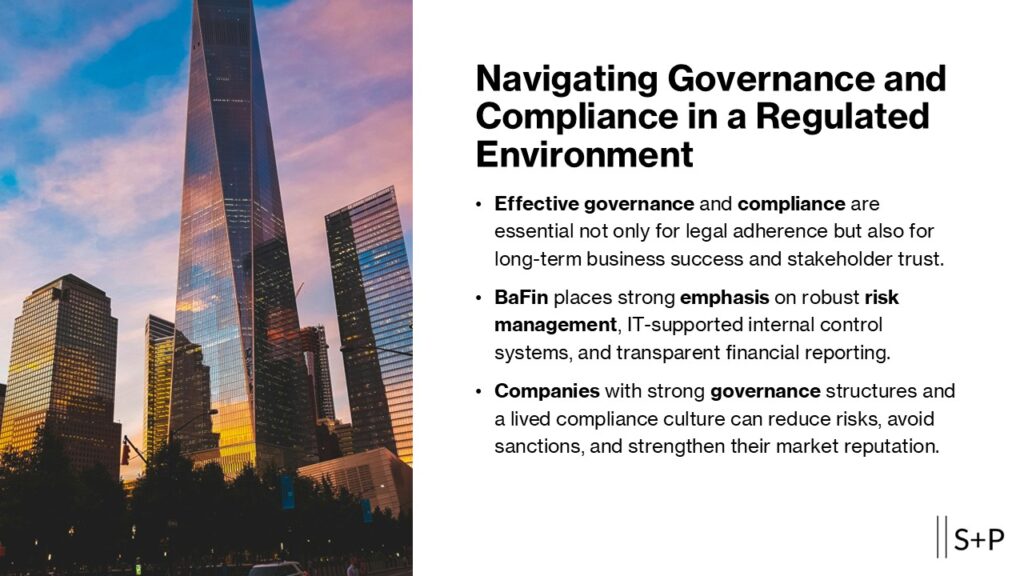
In today’s business world, complying with regulatory requirements is not just a legal necessity but also a crucial factor for long-term success and stakeholder trust.
The definition and concept of governance and compliance are central: Governance describes the systems, structures, and processes by which organizations are directed and controlled, while compliance refers to a company’s adherence to laws, policies, and voluntary codes. Understanding the precise definition of these terms is essential to grasp their significance for corporate governance and compliance management.
The Federal Financial Supervisory Authority (BaFin) plays a central role in Germany in monitoring and regulating the financial market to ensure the integrity, transparency, and stability of the financial system. Companies subject to BaFin examinations must therefore pay particular attention to adhering to corporate governance, internal control systems, and compliance guidelines. This article explores how companies can safely navigate the complex web of governance and compliance.
Internal Control System (ICS)
An effective internal control system is essential for early risk detection and ensuring operational efficiency. It includes measures for monitoring and controlling business activities, including financial reporting, fraud prevention, and compliance with legal requirements. Data protection and data governance are central components to ensure quality, security, and compliance in handling sensitive data. Compliance with regulations, rules, and legal requirements, as well as a well-defined framework for compliance and internal controls, are essential for an effective ICS. Various mechanisms, such as control processes and monitoring systems, ensure that compliance requirements are efficiently met.
In view of increasing requirements from BaFin, a modern ICS must be IT-supported today. This is the only way to efficiently process complex mass data and ensure data integrity seamlessly throughout the process – a central point of evaluation in modern regulation.
BaFin’s focus is particularly on the effectiveness of risk management, the adequacy of control measures, and the integrity of financial reports.
Compliance: More Than Just Rule Compliance
| Area | Core Focus & Definition | Strategic Benefit / Goal |
|---|---|---|
| Corporate Governance | System of structures and principles for responsible management (e.g. German Corporate Governance Code – DCGK). |
Strengthens market trust and ensures long-term value creation. |
| Compliance (CMS) | All measures to comply with laws, internal guidelines, and company-wide values. |
Avoidance of sanctions and liability risks; creation of sustainable competitive advantages. |
| Risk Management | Systematic identification, assessment, and control of potential dangers, risks, and rule violations. |
Risk minimization and proactive preparation for BaFin examinations. |
| Internal Control (ICS) | Monitoring and controlling of processes by management (separation of management and control). |
Ensuring operational efficiency and organizational integrity. |
| Special Governance | IT governance, ESG governance, and project governance for specific specialist and functional areas. |
Aligning IT and sustainability with strategic corporate goals. |
| Corporate Culture | Anchoring ethics, integrity, and social responsibility in everyday business. |
Tone from the Top and sustainable trust-building with internal and external stakeholders. |
Strategies for Successful Navigation
- Strengthening governance structures: Companies should establish clear responsibilities and processes that support transparent and responsible corporate management. Establishing governance committees and regularly training the board and supervisory board are essential.
- Implementing robust ICS procedures: Developing and continually reviewing internal control systems help effectively manage operational and financial risks. Automated solutions and technologies can improve the efficiency and effectiveness of the ICS.
- Promoting a compliance culture: Compliance should be integrated into the corporate culture with strong management commitment. Regular compliance training and clear communication channels are crucial to promoting awareness and adherence.
- Proactive risk assessment and management: Companies must engage in proactive risk management that involves identifying, assessing, and controlling risks. This also includes preparing for BaFin examinations through regular internal audits and reviewing compliance programs.
- Transparent reporting and communication: Providing transparent and accurate information to BaFin and other stakeholders is crucial. Companies should establish effective communication strategies to document and communicate regulatory compliance.
Conclusion
Complying with BaFin’s requirements through effective corporate governance, internal control systems, and compliance measures is no easy task. It requires continuous efforts, commitment, and resources. However, companies that master this challenge can not only avoid regulatory sanctions but also enhance their reputation, increase stakeholder trust, and ultimately secure their long-term success.
The navigation through governance and compliance in the focus of BaFin examinations is therefore a crucial step for any company wishing to succeed in today’s complex and regulated financial world.
FAQ: Navigating Governance, Compliance, and BaFin Examinations
- What is the fundamental difference between governance and compliance?
Governance provides the framework: It includes the systems, structures, and principles by which a company is managed and controlled.
Compliance, on the other hand, is the operational implementation within this framework –
namely the active adherence to laws, guidelines, and ethical standards.
While governance defines “how we lead”,
compliance ensures that “we play by the rules”. - Why is corporate governance so critical in the context of a BaFin examination?
BaFin examines not only individual cases but the
quality of overall corporate management.
Strong corporate governance shows that responsibilities –
such as between the board of directors and the supervisory board – are clearly separated
and effective control mechanisms exist.
Transparency and consideration of stakeholder interests
are central evaluation criteria for supervision. - What role does the Internal Control System (ICS) play in supervision?
The Internal Control System acts as the
company’s early warning system.
BaFin places special emphasis on the effectiveness of risk management
and the integrity of financial reporting.
A robust ICS ensures that errors or fraud attempts
are detected early – before they jeopardize the stability of the financial system
or investor confidence. - What is meant by a “lived compliance culture”?
Compliance is more than a set of rules in a drawer.
A lived compliance culture means that
integrity and ethical behavior
are firmly anchored in corporate values.
The commitment must come from the company’s management
(Tone from the Top).
Companies with a strong compliance culture not only
reduce liability risks but often gain
competitive advantages in public tenders. - How do I optimally prepare my company for a BaFin examination?
Successful preparation is based on five key strategies:
- Strengthening structures: Clear responsibilities and regular training for committees.
- Digitizing ICS: Using automated technologies for risk monitoring.
- Promoting culture: Establishing compliance as a fixed part of internal communication.
- Proactive audits: Conducting internal examinations to identify weaknesses early.
- Transparency: Comprehensive documentation and open communication with the supervisory authority.
- What are the consequences of poor governance?
In addition to severe fines from BaFin,
the indirect consequences often weigh significantly more.
These include a significant loss of reputation,
loss of trust in the capital markets,
and exclusion from important mandates or contracts.
These factors can seriously threaten the long-term success of the company.