What are the 4 Project Phases in Project Management?
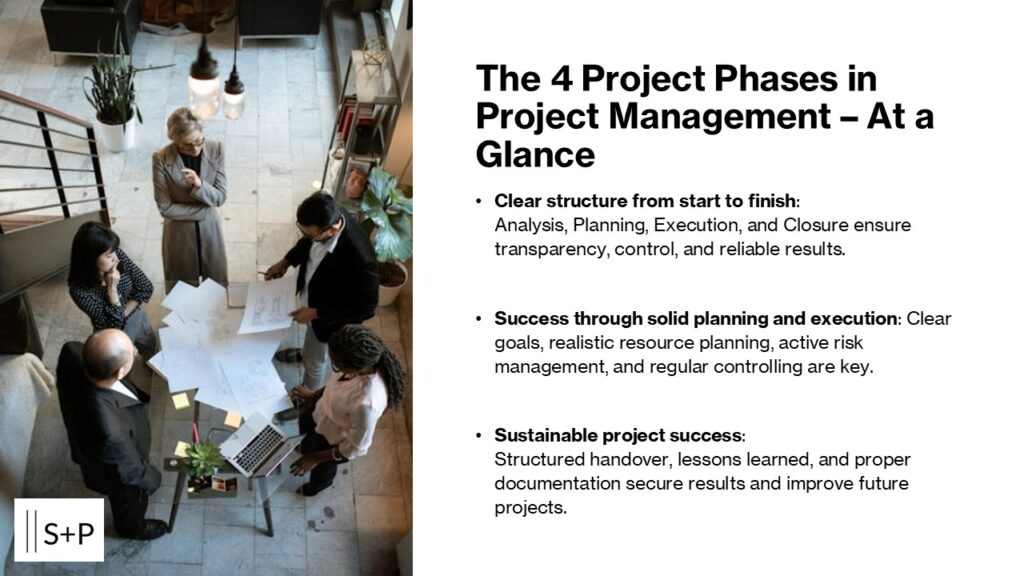
Effective project management follows a clear process: Analysis → Planning → Execution → Closure. Each phase has its own objectives, tasks, and typical risks. Here you get a compact, practical guide – including checklists, examples, and a placeholder table for your project data.
Phase 1: Analysis – Clarifying Objectives, Benefits & Feasibility
Goals: Sharpen project goals, assess business value, evaluate feasibility.
To-dos:
- Capture stakeholders & requirements (Scope, Must/Should/Nice)
- High-level effort/cost and risk estimation
- Decision basis: Secure Go/No-Go & sponsorship
Outcome: Project One-Pager (goal image, benefits, scope, rough resources & risks).
Phase 2: Planning – Structuring & Scheduling Realistically
Goals: Create an actionable plan, clarify responsibilities.
To-dos:
- WBS/Backlog, milestones & roadmap (Gantt/Kanban)
- Resource & cost plan, communication and risk plan
- Prepare kick-off: Roles, timeboxing, Definition of Done
Outcome: Coordinated project plan including communication and risk management.
Phase 3: Execution – Managing, Reporting Transparently, Managing Risks
Goals: Create deliverables on time and with the right quality.
To-dos:
- Manage sprint/work cycles, daily/weekly stand-ups
- Measure progress (Burndown, Earned Value, milestone trend)
- Control changes (Change Requests) & ensure quality (Reviews/Tests)
Outcome: Increments/deliverables, updated plans, documented decisions.
Phase 4: Closure – Capture Learning, Secure, Hand Over Cleanly
Goals: Handover project results, capture learning, formally close.
To-dos:
- Acceptance & handover (Operation/Owner), close open items
- Final report (goals, KPIs, budget, deviations)
- Retro/Lessons Learned & archiving (Documents, artifacts)
Outcome: Accepted deliverables + final documentation with lessons learned.
The 4 Project Phases in Project Management: Overview
| Phase | Description | Tasks and Goals |
|---|---|---|
| Analysis | Definition and feasibility check of the project goals | Goal definition, feasibility study, rough effort and cost estimation, selection of project participants |
| Planning | Detailed structuring and scheduling of the project | Creating project plans, scheduling, setting communication and marketing strategies, conducting a kick-off meeting |
| Execution | Managing and controlling the project, coordinating tasks | Regular planning meetings, progress control, quality assurance, problem management and adjustment of the project plan |
| Closure | Securing results and official project closure | Project review, preparing a final report, formal project closure |
Common Pitfalls and How to Avoid Them
- Unclear Goals/Scope Creep: Early goal definition + change process.
- Unrealistic Deadlines: Add buffers, assess capacities realistically.
- Communication Gaps: Fixed communication plan, one channel for decisions.
- Risks Without Owner: Risk log with owner, impact/probability, countermeasures.
SMART Goals in a Nutshell
Define goals Specific, Measurable, Attractive, Realistic, Time-bound – and link them with clear acceptance criteria (Definition of Done).
Learn in the post What is SMART in Project Management?, how to formulate goals that are measurable, realistic, and motivating – including practical examples for direct implementation.
Case Study: Successful Implementation of a New Software Solution
A medium-sized company faced the challenge of implementing a new software solution to increase the efficiency of its business processes.
- In the analysis phase, the goals and requirements of the software were clearly defined.
- The planning phase included creating a detailed project plan and involving all relevant departments.
- During the execution phase, regular meetings were held to monitor progress and quickly resolve any issues.
- In the closure phase, the software was successfully implemented, and a comprehensive final report was created confirming the achievement of objectives.
Your Next Step: Managing Projects with System
Project Manager Update – Management, Resources & Risk
With the S+P Project Management Seminars, you will learn to manage projects structurally, minimize risks early and reliably meet budgets & deadlines. Includes S+P Tool Box Project Management (Templates, Gantt templates, risk checks) and Certificate: S+P Certified Project Leader.
Your Benefits at a Glance
- Clear Structure & Goals: Project sizing, prioritization, realistic roadmaps
- Resources & Controlling: Manage capacities, early warning systems & risk management
- Methods Fit: Combine agile & classic – immediately applicable with the S+P Tool Box
FAQ – The 4 Project Phases in Project Management
What phases does a project typically include?
A project typically divides into four phases:
Analysis, Planning,
Execution, and Closure.
This structure ensures clarity, control, and a clean transfer of results.
What is the goal of the analysis phase?
In the analysis phase, project goal, benefits, and feasibility are clarified.
This includes capturing requirements, a rough effort,
cost, and risk assessment, and deciding on Go or No-Go.
What tasks are included in the planning phase?
In the planning phase, the project is structured and realistically scheduled.
Typical tasks include project and resource planning,
milestones, communication and risk plans, and preparing the kick-off.
How to manage the execution phase effectively?
The execution phase is managed through regular alignments,
progress measurement (e.g. milestones, KPIs),
controlled change management, and quality assurance.
Transparent reports and documented decisions are crucial.
What happens in the closure phase of a project?
In the closure phase, the results are accepted and handed over,
open points are closed, and a final report is created.
Additionally, lessons learned are documented to secure experiences for
future projects.
What are typical pitfalls in project management?
Common pitfalls include unclear goals (Scope Creep),
unrealistic deadlines, lack of communication,
and unmanaged risks.
These can be avoided through clear goal definition,
realistic planning, and active risk management.
How to formulate SMART goals in a project?
SMART goals are specific, measurable, attractive, realistic, and time-bound.
They are linked with clear acceptance criteria (Definition of Done),
to clearly assess progress and achievement.
Are there practical examples for the four project phases?
Yes. In practice, it is shown for example in software implementations,
that a clean analysis of requirements,
realistic planning, regular reviews in execution,
and a structured closure are crucial for project success.
How does the S+P Tool Box support me in project management?
The S+P Tool Box supports you with immediately usable templates,
checklists, Gantt templates, and risk checks for all project phases.
This manages projects in a structured, efficient, and practical way.
Other Relevant Topics & Practical Tips
- What is Project Management? – Basics, Goals and Benefits
- Understanding Scrum – How Agile Project Management Works
- Scrum: What is a Sprint?
- Project Risks – What Really Matters
- Project Management Training – Skills for Project Leaders
- Certificate Course Project Leader – With S+P Certified Degree
- What is a Sprint?